Created: 2026-03-08 10:48
Tags: #notes #gamedevelopment
Setup
Materials:
- White paper
- Notebook paper
- Graph paper
- Note cards
- Pencils (10)
- Markers (4 packs)
- Scissors (4)
🗒️Notes - STEM exploration Camp

- There are areas of CS people aren't very interested in
- And then there's game development
- We're going to talk about game development in a systematic way
- To be clear, this is going to be an offline game development
- Pencil and paper
- It would take way too long to get you started on Unreal or Unity or anything else
- But at the end, I will find a way to get you started down this path if you are truly interested
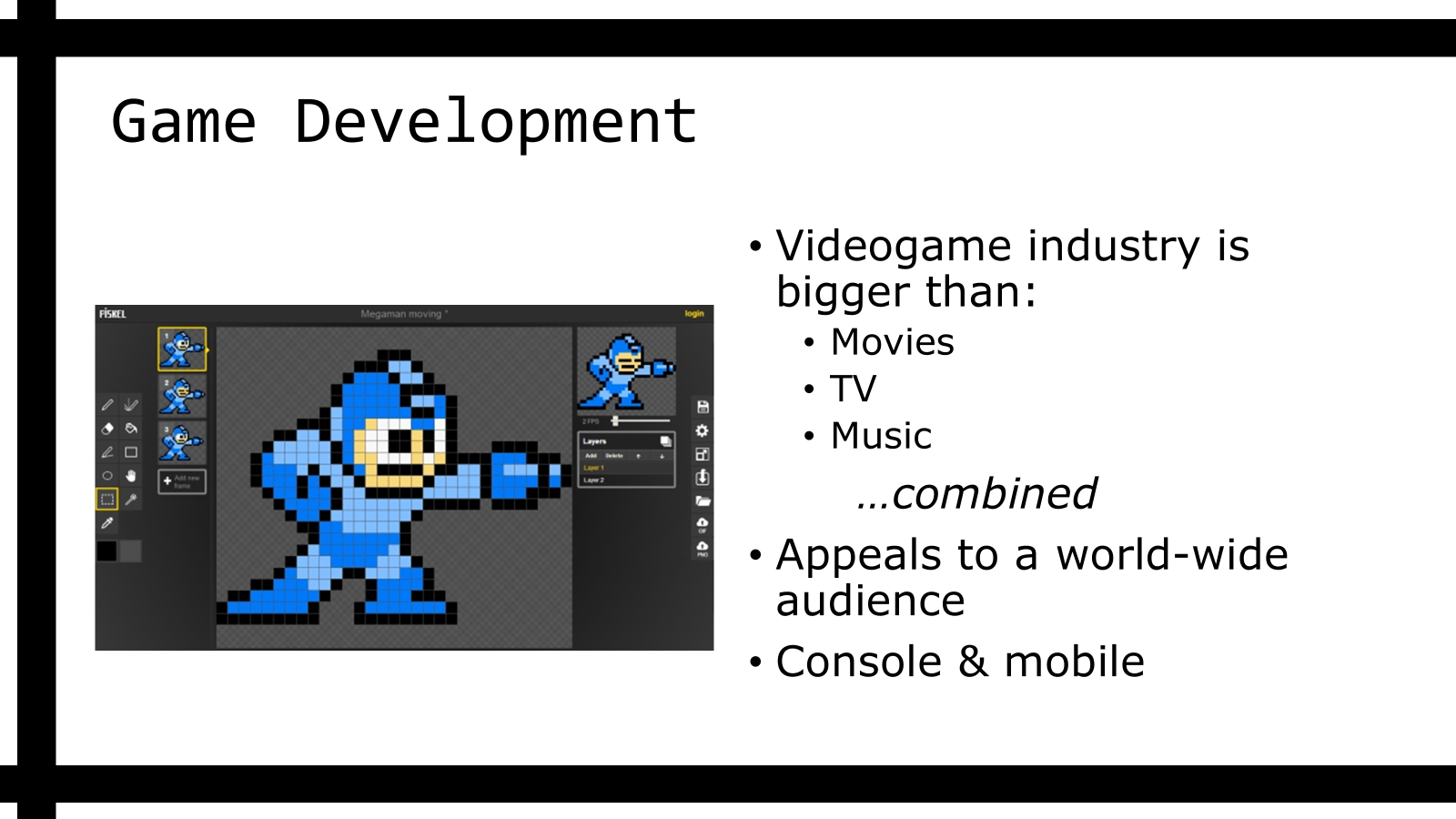
- Who knows who this guy is?????
- Who knows what these little squares are called?
- And why did they make art with these? Why not just draw straight lines?
- How many people play mobile games?
| Industry | Global annual revenue (approx.) | Source |
|---|---|---|
| Video games | $183.9B | Newzoo estimate for 2023 global games revenue |
| Movies (box office only) | $33.9B | Gower Street estimate for 2023 global box office |
| Music (recorded music only) | $28.6B | IFPI 2023 global recorded music trade revenue |
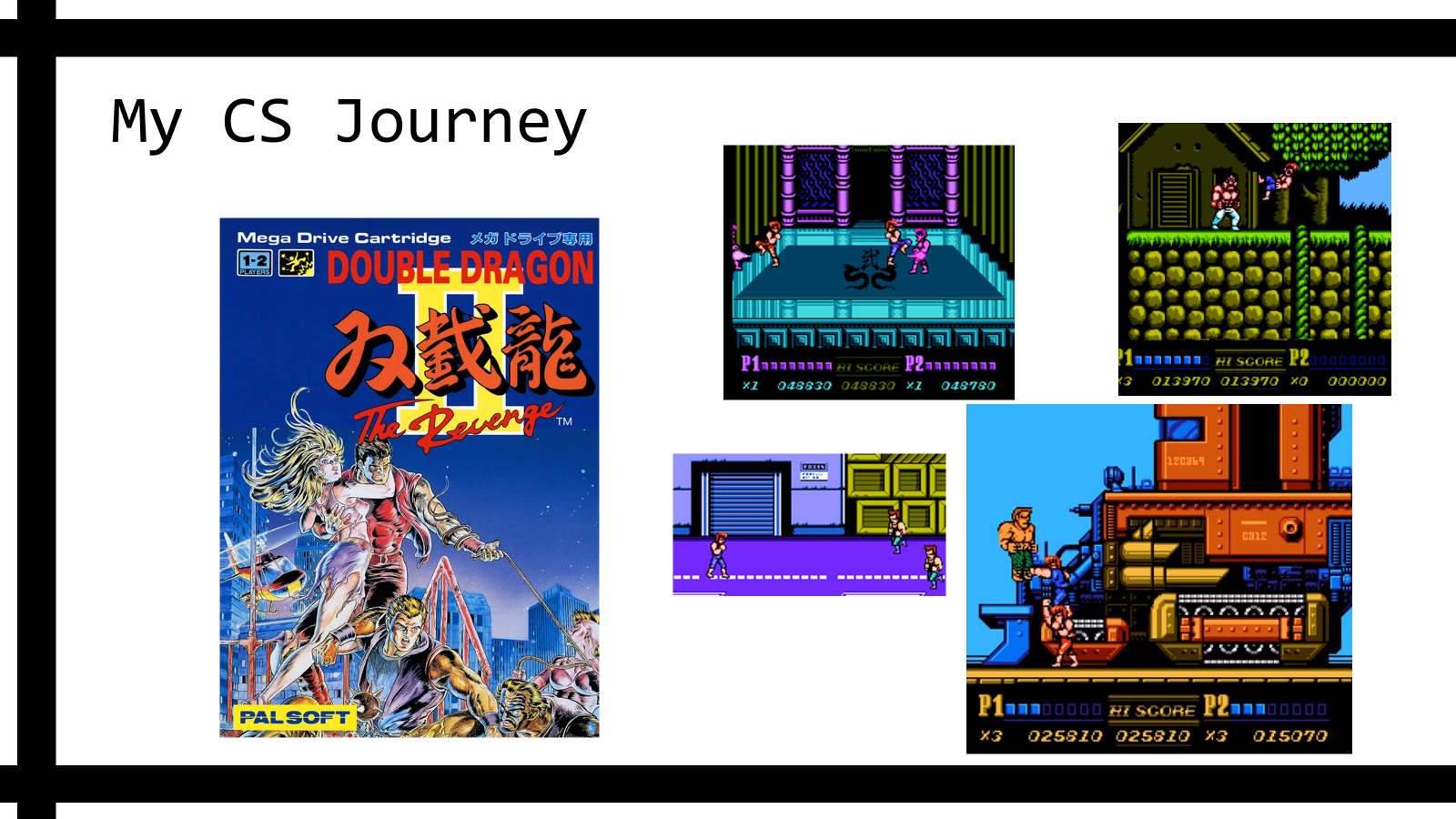
- Picture it: the year is 1989. I'm in 4th grade. For my birthday, I get this game
- And I'm obsessed with it for the rest of my life
- Flash forward 10 years, and I have a computer and I want to make improvements to this game
- Eventually, I want to make it into a different type of game
- Anyone ever heard of a mod?
- Who has ever used a mod?
- Who has ever had an idea for a mod?
- Who has actually made a mod?
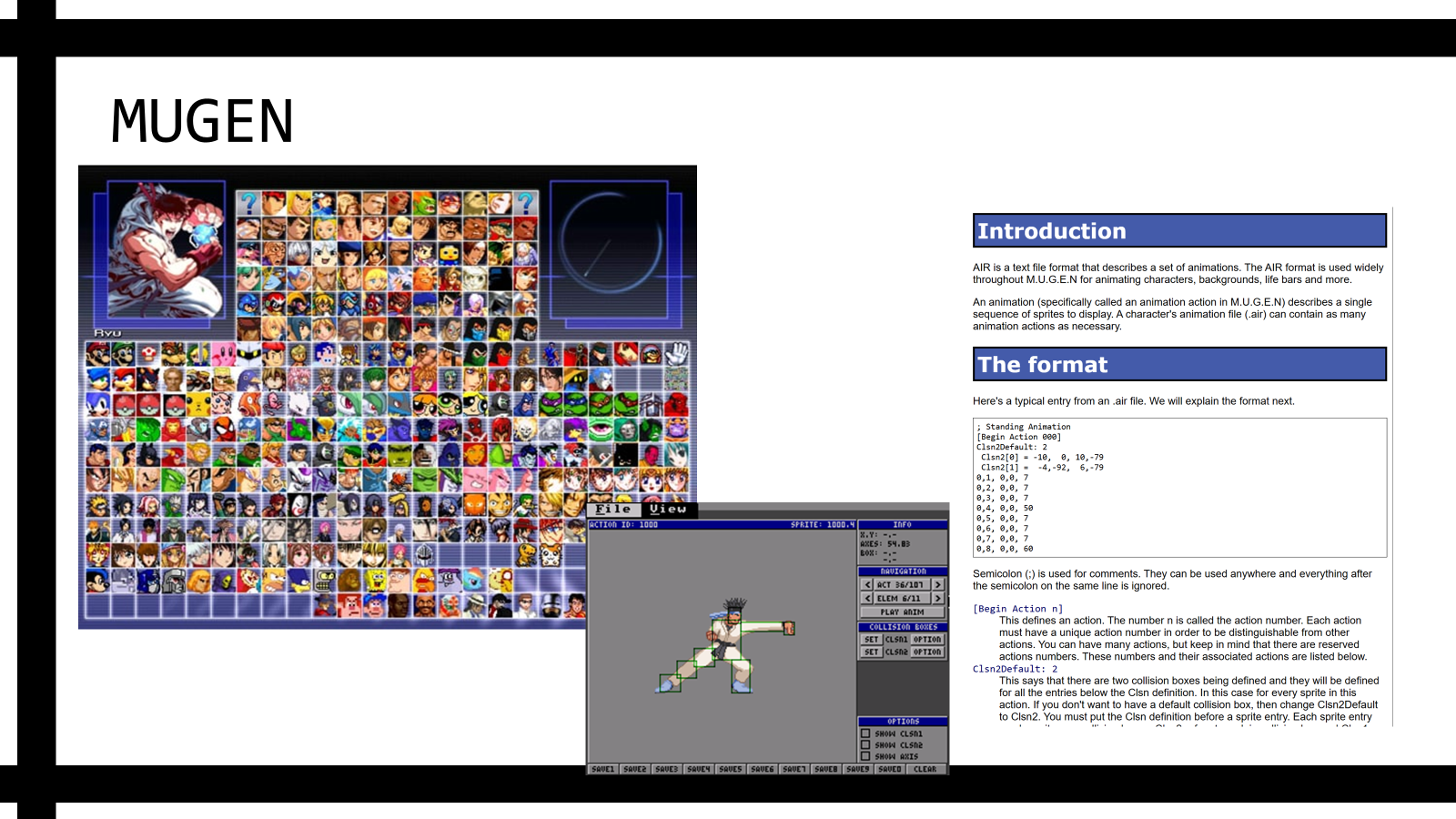
- My platform was called MUGEN
- This is when I first started to truly realize what it takes to make a video game
- It's not just art and visuals
- There's math, physics, programming
- In other words, rules
- Everything needs to be quantified
- Everything needs to be systematic
- Who knows what these little boxes are called?
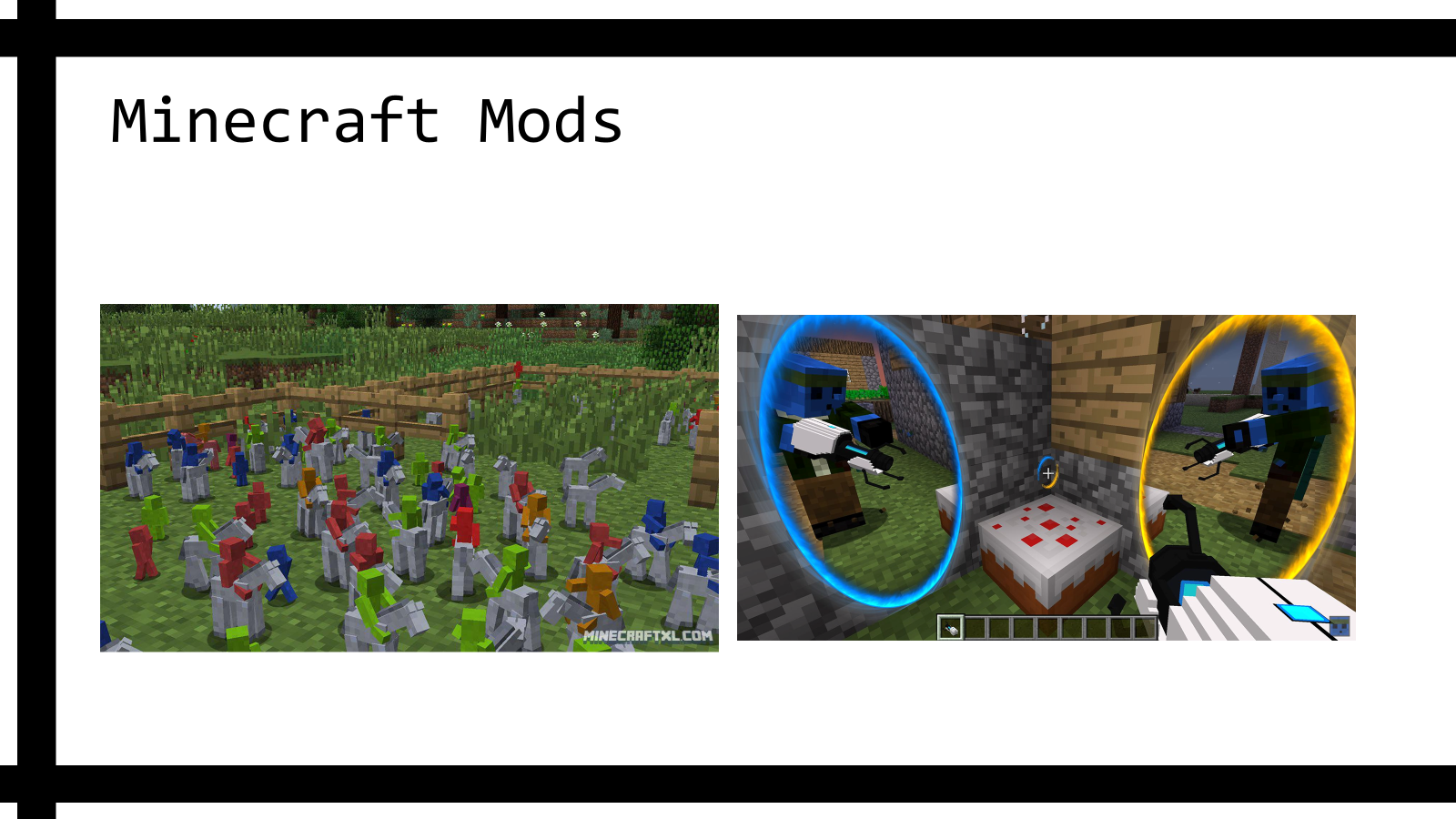
- I strongly encourage students your age and younger to get involved with modding
- I honestly don't know what the mod is on the left
- I do know what the mod is on the right--anyone ever heard of a game called Portal?
- Pretty cool concept, I hope they remake it
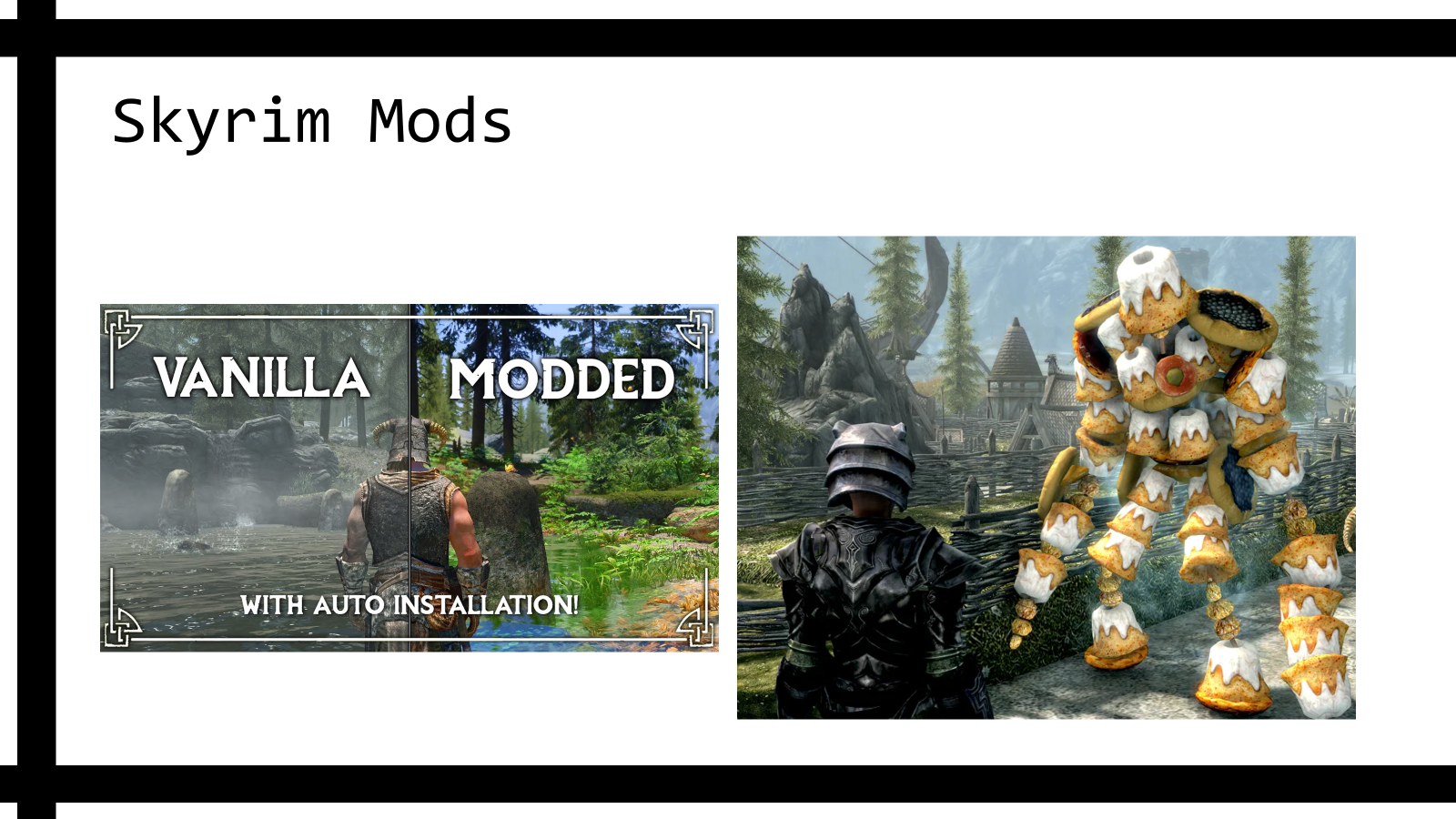
- Notice this word "vanilla"--that just means unmodded
- So let's think through game design in a systematic way
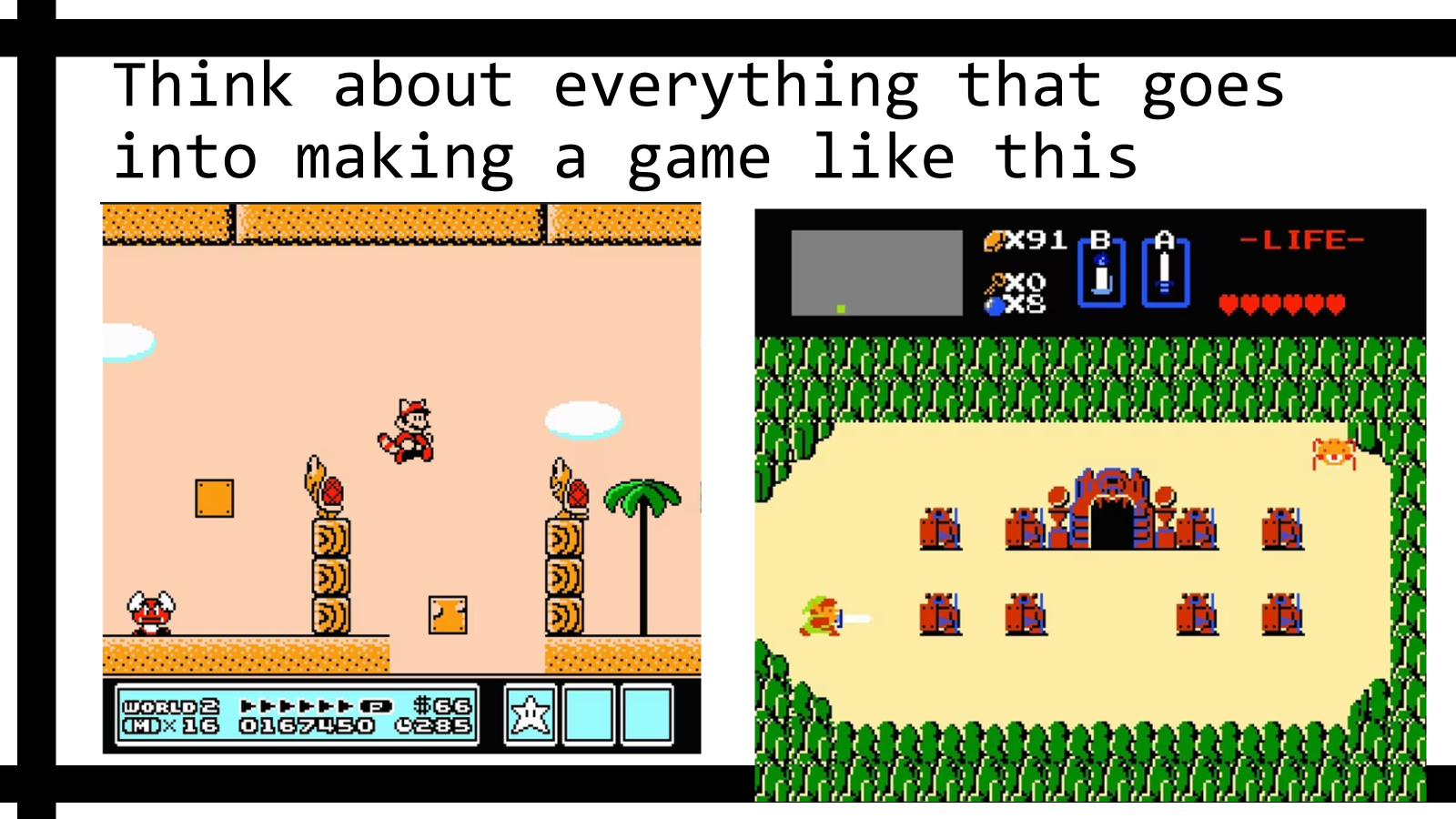
- Look at these games, hopefully the graphics will be familiar to you
- Now the art is simple and beautiful
- But think about all the systems that have to be in place for the game to function
- Mario's lives
- World tracker
- P-meter
- Score
- Coins
- Time
- Item cards
- collusion detection
- What happens if Mario jumps on a turtle?
- what happens if the turtle touches him?
- What happens if Link goes into the door?
- What happens if Link touches the knight?
- Item inventory
- Life bar, magic, stamina
- Collision detection
- Water
- Enemy AI
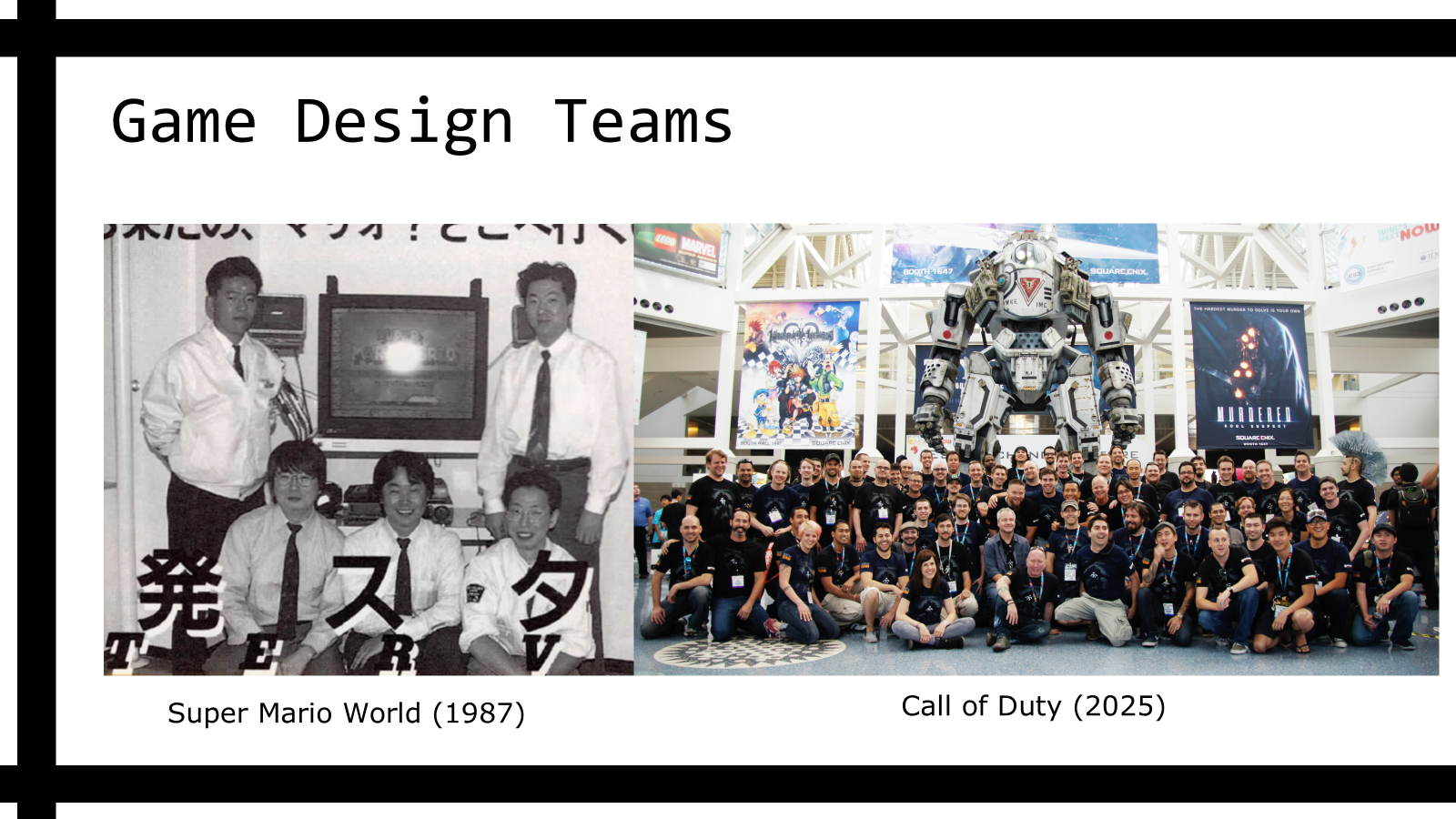
- One of these men is the most successful and famous game developer of all time
- Remember, games are a big business!
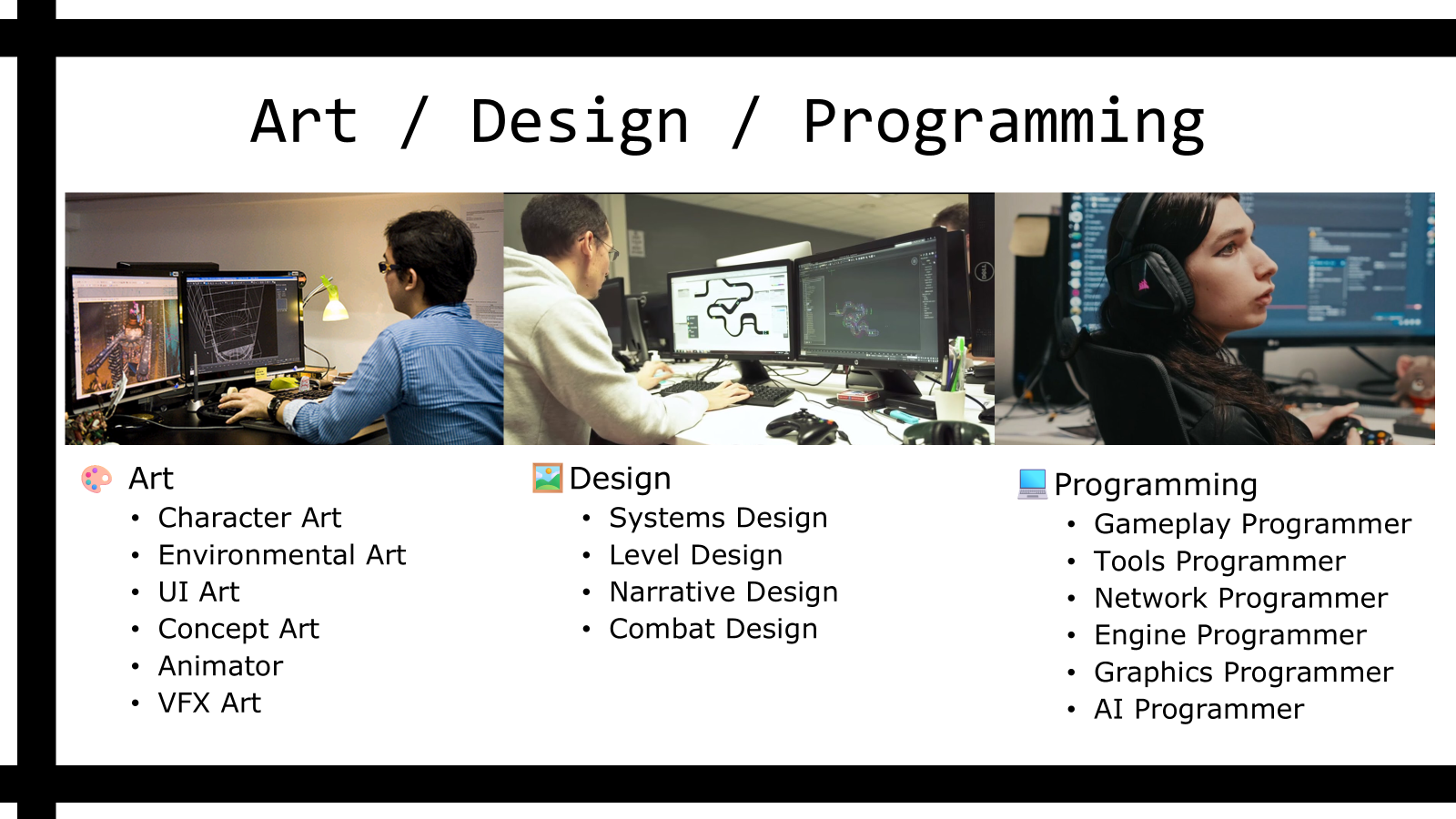
- simplified version
- Programmers make the most by the way

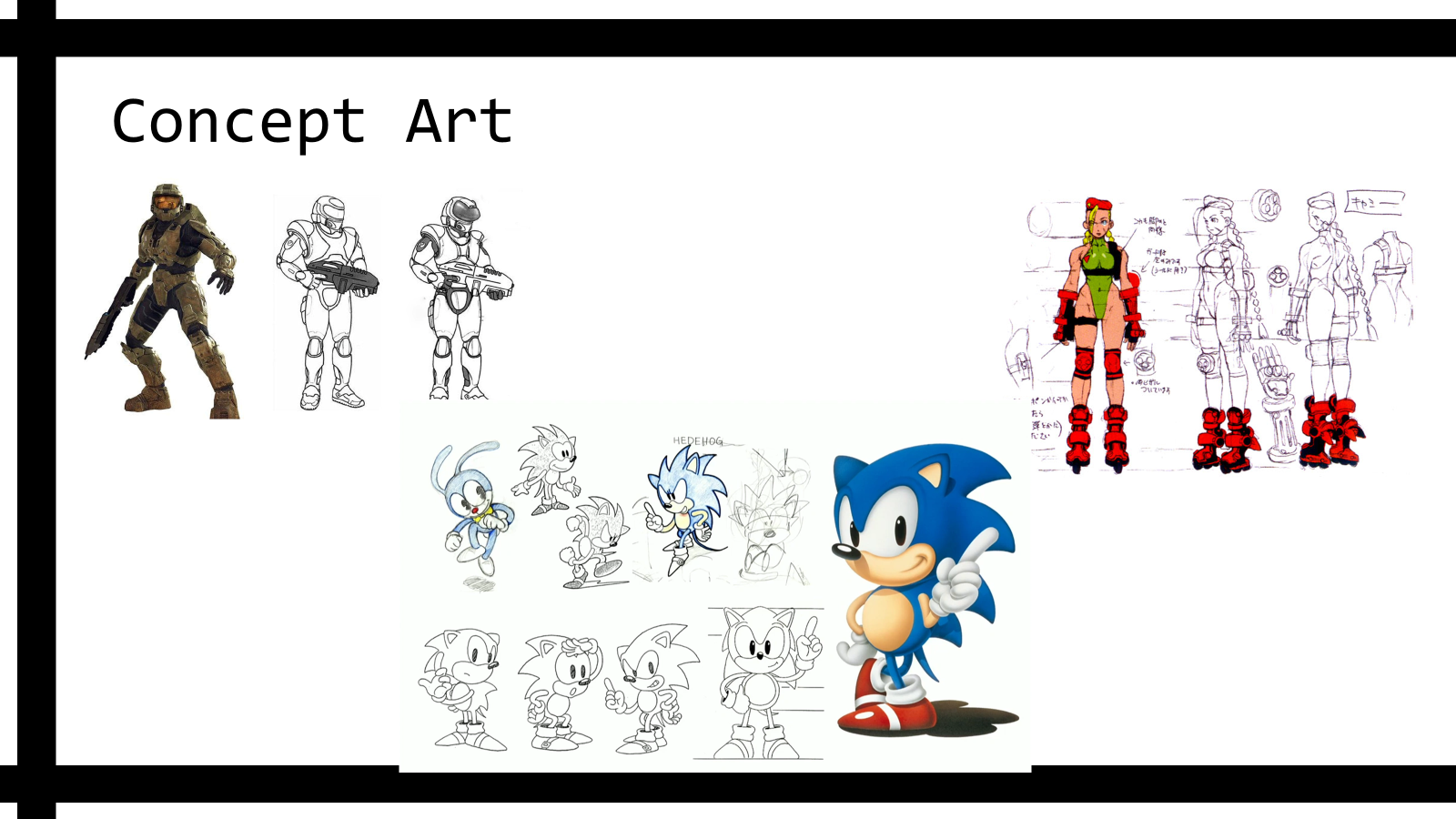
- These are the rough drafts of characters
- Notice the early versions
- Sonic as a bunny
- Cammy has rollerblades
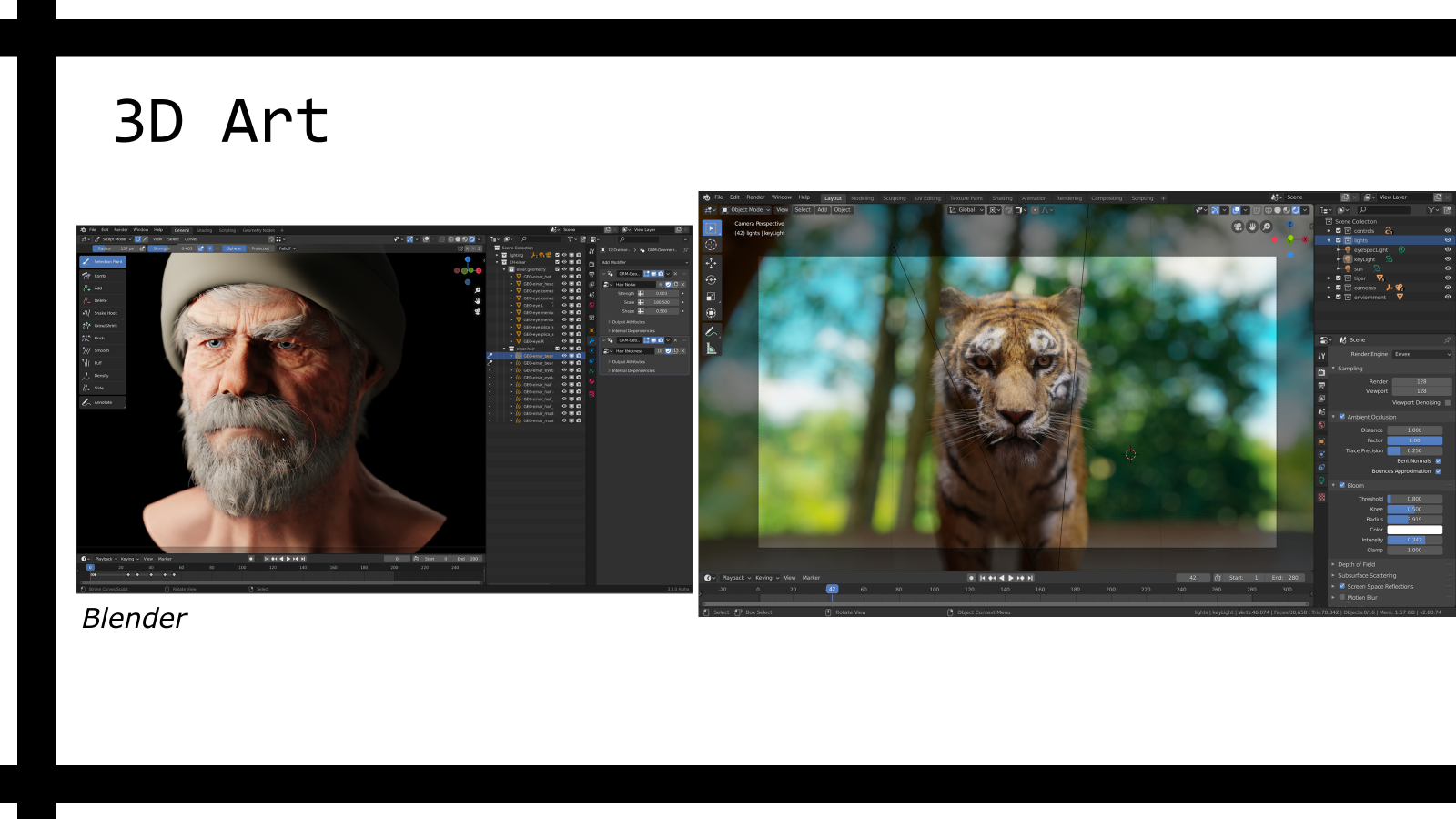
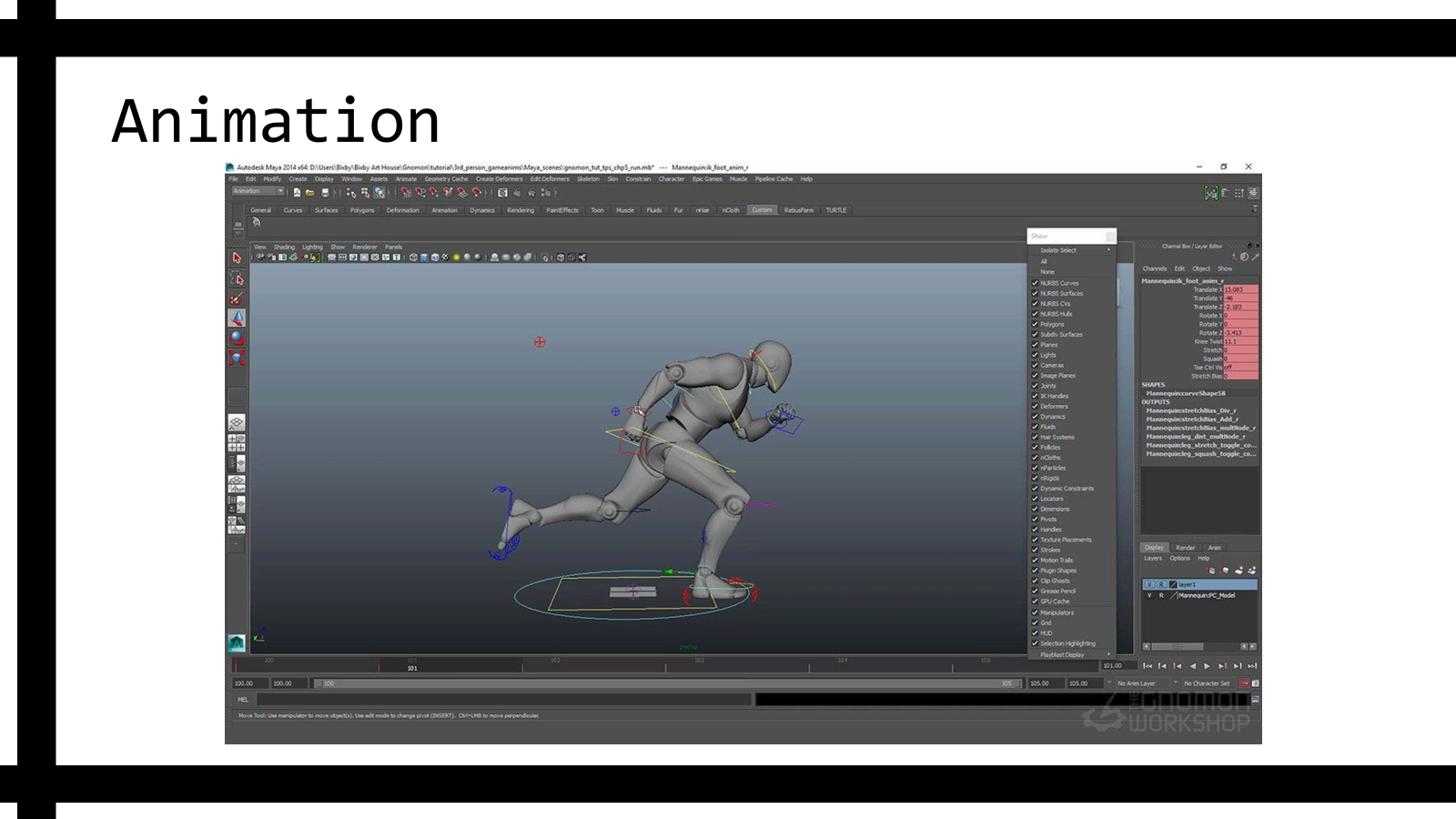
- Blender is a 3D art
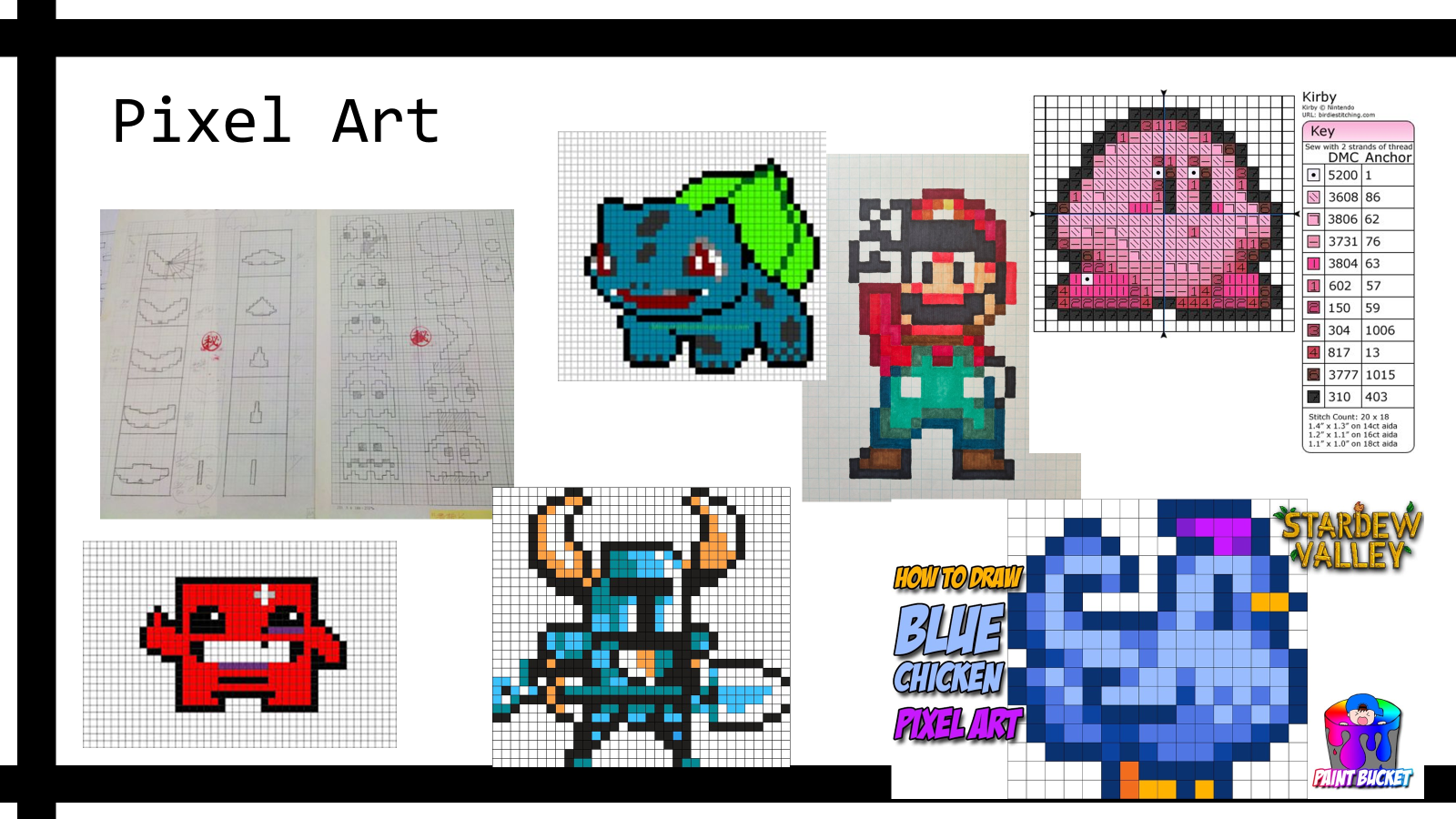
- Pixel art is retro AND current
- Pixel art was born out of graphical limitations
- It went away, and came back!
- Much like vinyl records
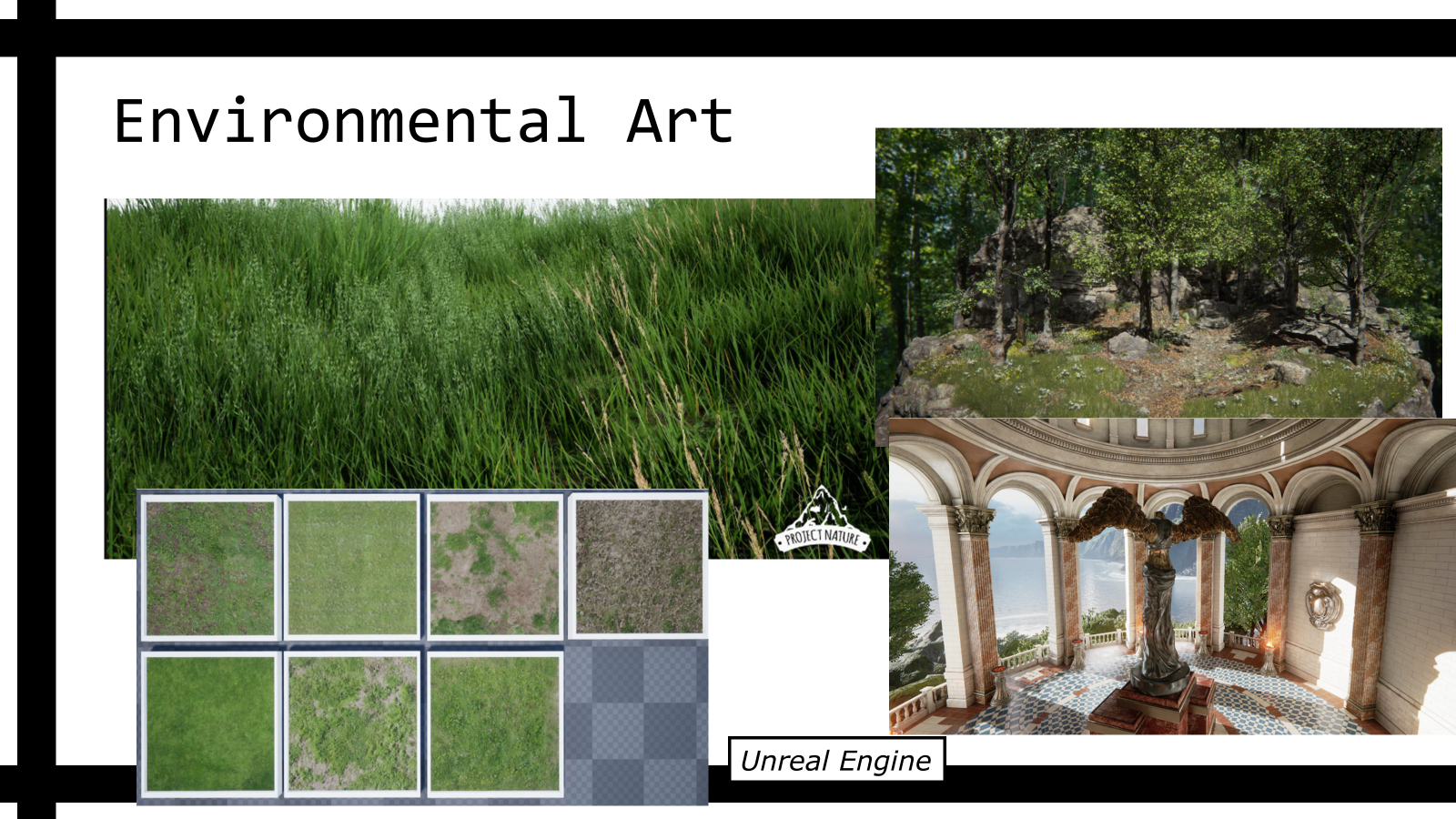
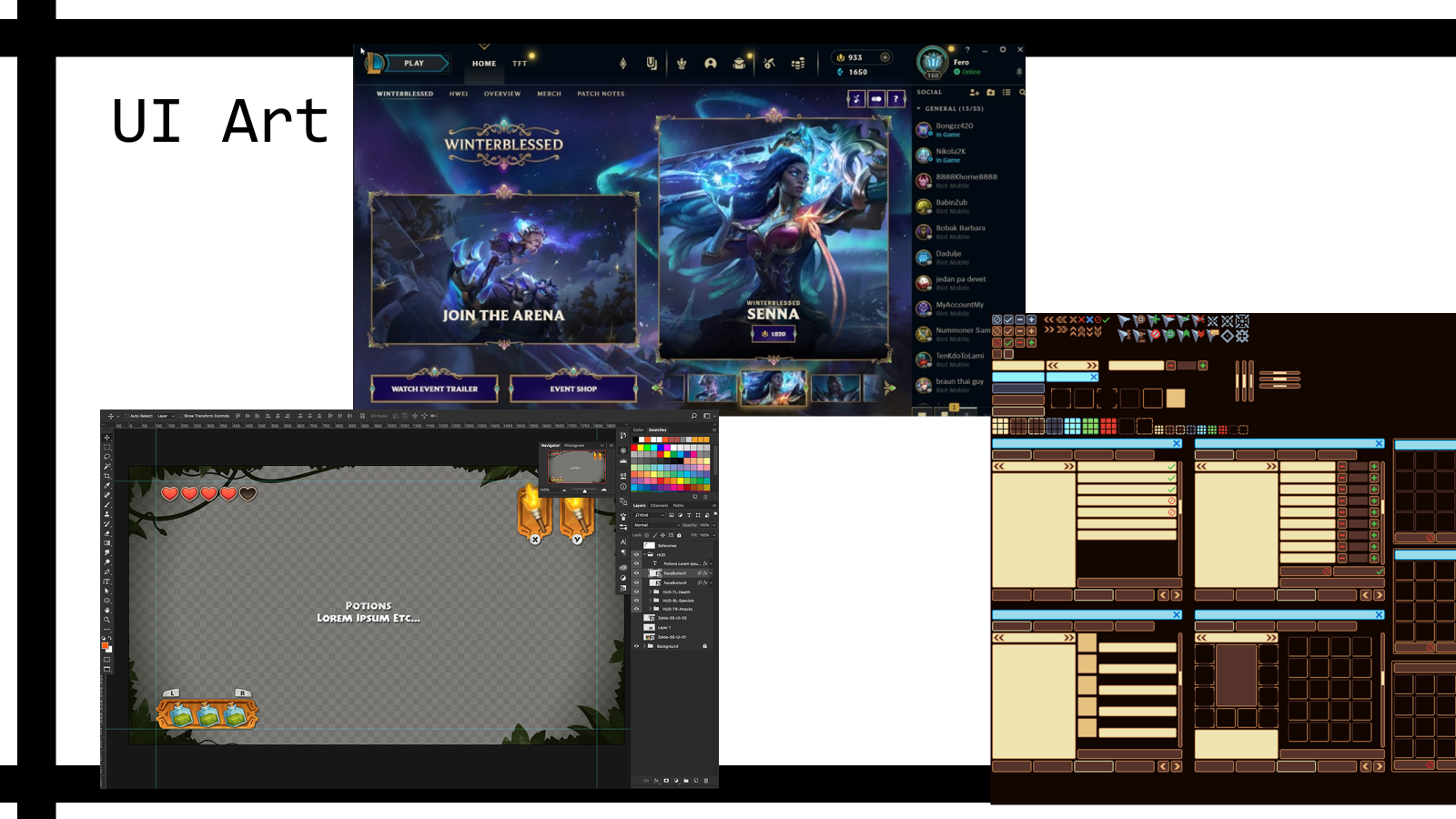
- UI art is a whole area as well
- Imagine for example if you switched the UI of these 2 images
- This is what they call the "look & feel"

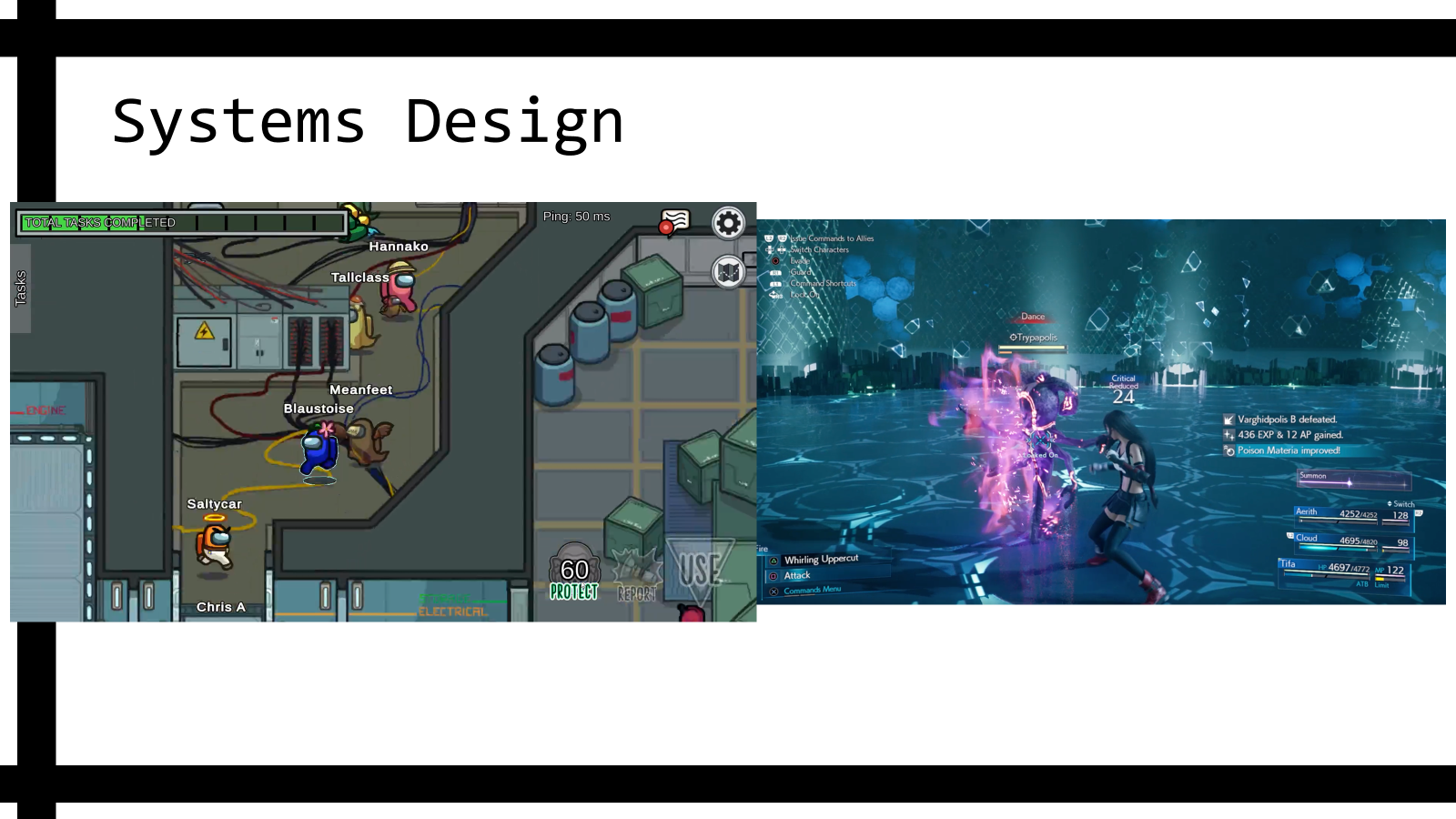
- Again I ask you to think of everything in a game like this
- Among Us:
- What are the systems? In other words, what are the rules?
- Final Fantasy VII Remake:
- Leveling, life, damage, special abilities
Claude notes
What systems design is
- The practice of designing the rules, mechanics, and economies that make a game function
- The invisible layer underneath everything — when it works, players don't notice it
- If art is what the game looks like and programming is how it runs, systems design is what it means to play it
- Every number in a game — damage values, jump height, enemy speed, spawn rates — was a systems design decision
- The best definition: systems designers make interesting decisions happen without the player noticing anyone designed them
Core concepts
- Core mechanic — the one thing the player does over and over. Jump, shoot, build, sneak, match. Everything else in the game should support and complicate that one thing
- Game loop — the cycle of actions the player repeats. In Mario it's run, jump, collect, reach flagpole, repeat. Every game has one whether it was designed explicitly or not
- Economy — any system where resources are earned, spent, and balanced. Health, ammo, money, experience points, time. Economies create tradeoffs which create decisions which create gameplay
- Difficulty curve — how challenge scales over time. Too flat and players get bored. Too steep and they quit. The curve is tuned through systems, not narrative
- Feedback loops — positive feedback rewards success with more power, negative feedback catches players who fall behind. Most good games use both simultaneously
- Emergence — when simple rules combine to create complex unexpected behavior. Chess has simple rules and effectively infinite gameplay. That's emergence
The tuning process
- Systems designers spend enormous amounts of time adjusting numbers — called tuning or balancing
- A weapon that does 10 damage versus 12 damage can fundamentally change how the game plays
- Playtesting exists almost entirely to find broken systems — interactions the designer didn't anticipate
- The question a systems designer asks constantly: "is this decision interesting?" A decision with one obvious answer isn't a real decision
- If players always choose the same option something is wrong with the system
What systems designers actually produce
- Game design documents — written descriptions of every mechanic, rule, and value in the game
- Spreadsheets — seriously, a huge amount of systems design happens in Excel or Google Sheets before any code is written
- Balance documents — tables showing how every weapon, character, or ability compares to every other one
- Flow diagrams — maps of how players move through systems and what triggers what
- Tuning builds — versions of the game with specific numbers adjusted for playtesting
The skills it requires
- Mathematical thinking — not necessarily advanced math but comfort with ratios, percentages, and probability
- Empathy — imagining how a player who isn't you will experience a system
- Systems thinking — seeing how changes in one area ripple through everything else
- Writing — design documents have to communicate complex ideas clearly to artists and programmers
- Humility — your best idea will probably get cut or changed based on playtesting and that's fine
Why it's harder than it looks
- Players are unpredictable. They will find exploits, shortcuts, and strategies the designer never imagined
- Systems interact with each other in ways that are impossible to fully predict before playtesting
- A system that looks perfectly balanced on paper often feels terrible to play, and vice versa
- The gap between "this makes logical sense" and "this is fun" is where systems designers live
Examples to point to
- Pokemon type chart — 18 types, dual typing, hundreds of matchup combinations, all from one well-designed table
- GTA wanted levels — five escalating states each triggering different responses, tuned to let players feel powerful right up until they feel overwhelmed
- Dark Souls death economy — dropping souls on death and having one chance to recover them is a single system that defines the entire emotional tone of the game
- Among Us kill cooldown — adjusting one number by a few seconds shifts the entire balance between impostors and crewmates
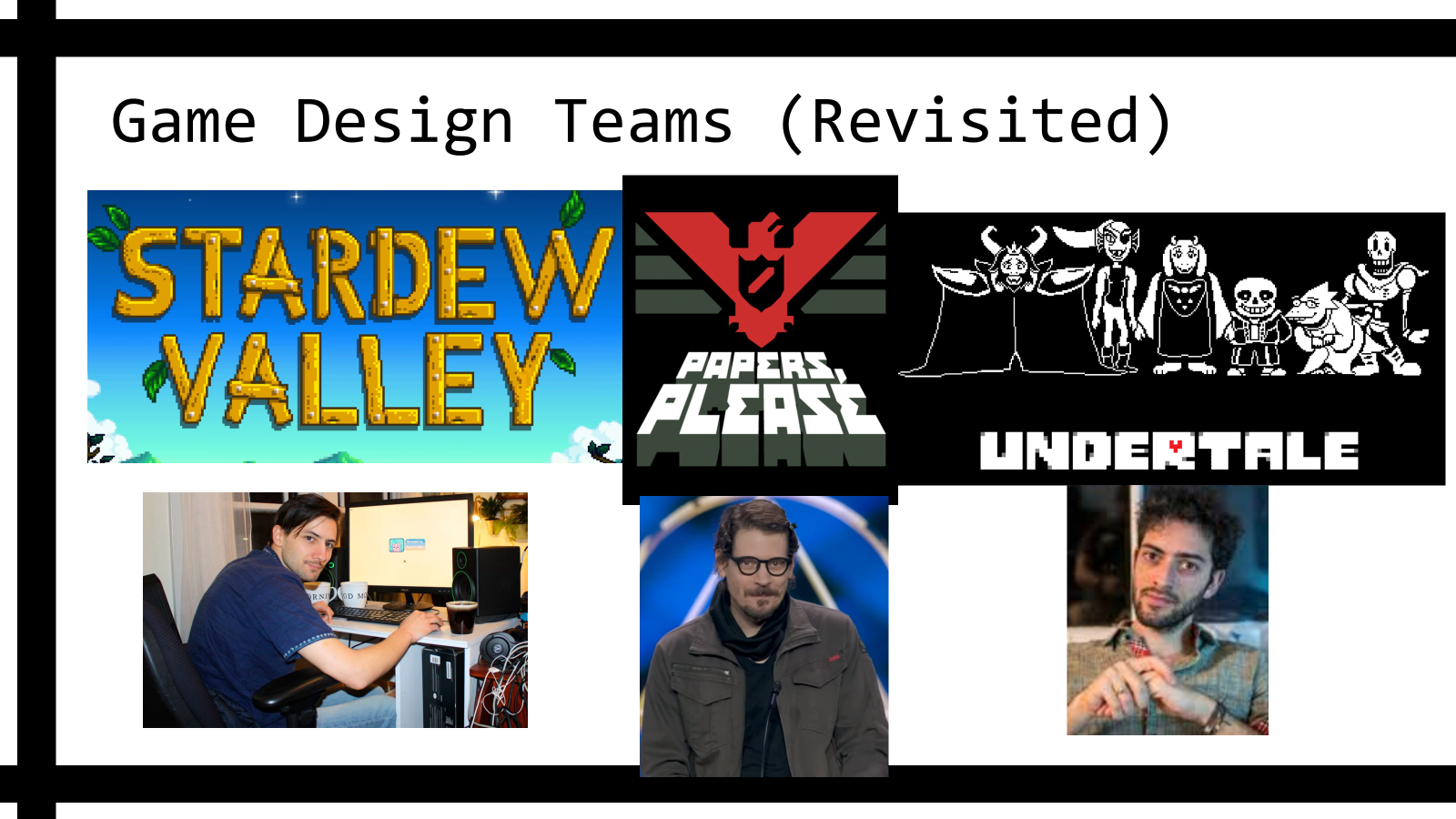
- Stardew Valley crop economy — every crop's growth time, sell price, and seasonal window was designed to create tradeoffs, all in a spreadsheet before any art existed
The connection to your workshop
- The rules card students write during the paper sprint is a systems design document
- Every If-Then rule is a system
- When another team playtests their game and finds something broken or unfair, that's the systems design feedback loop working exactly as it should in a real studio
- The question to ask students after playtesting: "was every decision you made as a player an interesting one?" If not, the system needs tuning
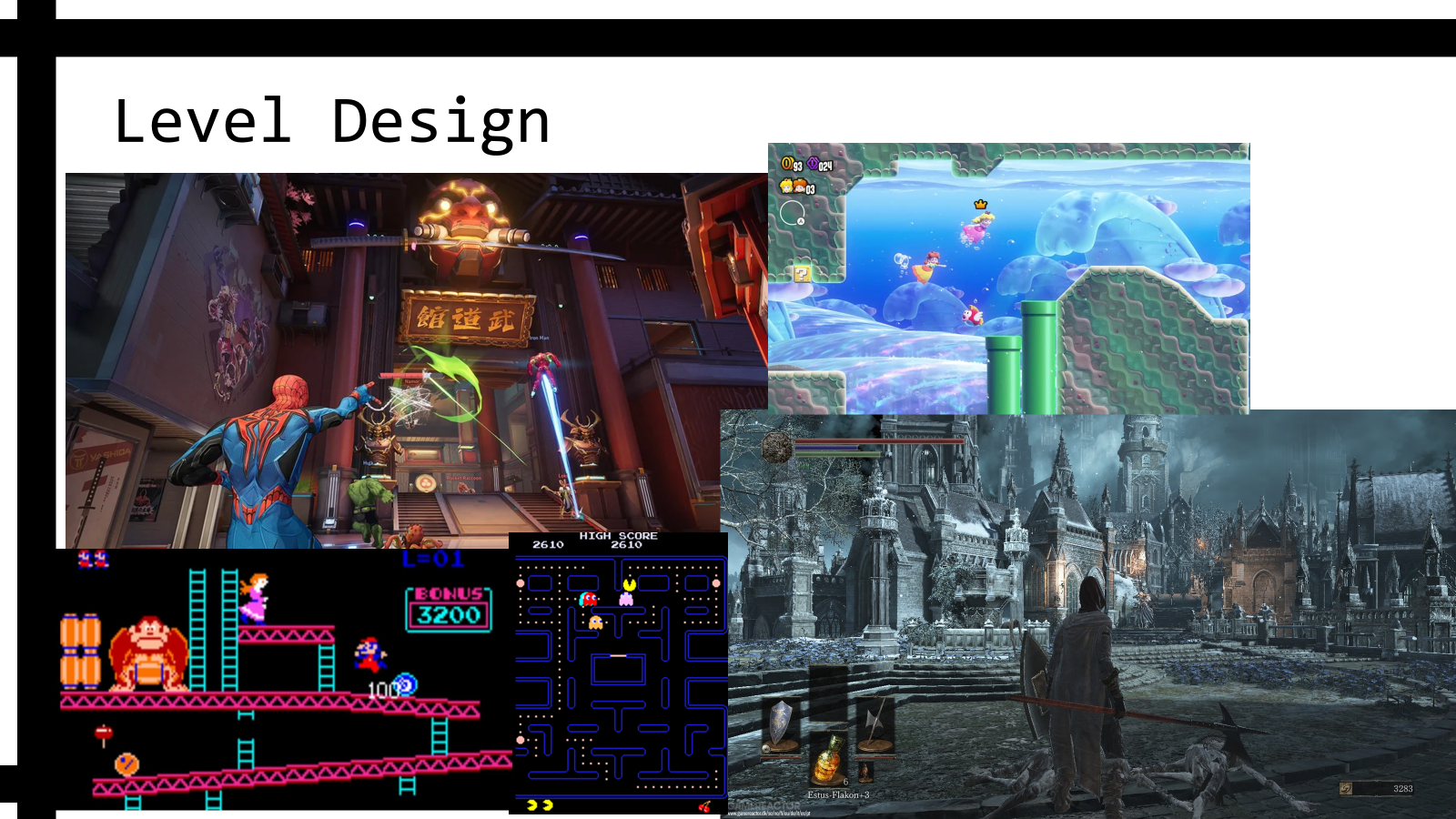
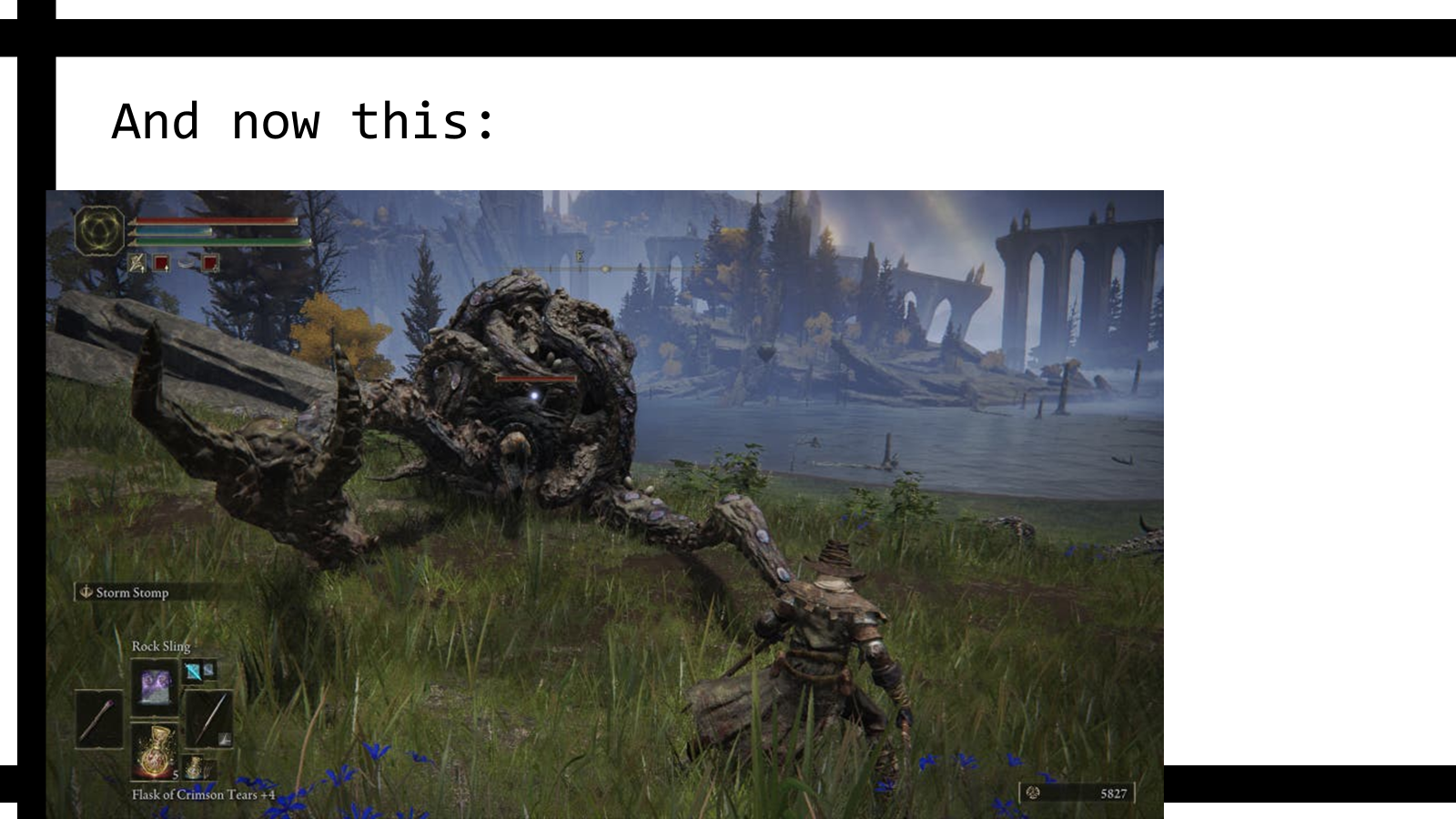
- Now once you have your character art, they have to have a place to play right?
- Here's some 3D and 2D examples
- Marvel Rivals is a hero shooter type game
- The levels are very important in this type of game
- Dark Souls, look at the level of detail in the buildings
- Interesting decision for your game design: are those buildings built separately? in separate space? or are the interiors on the same map?
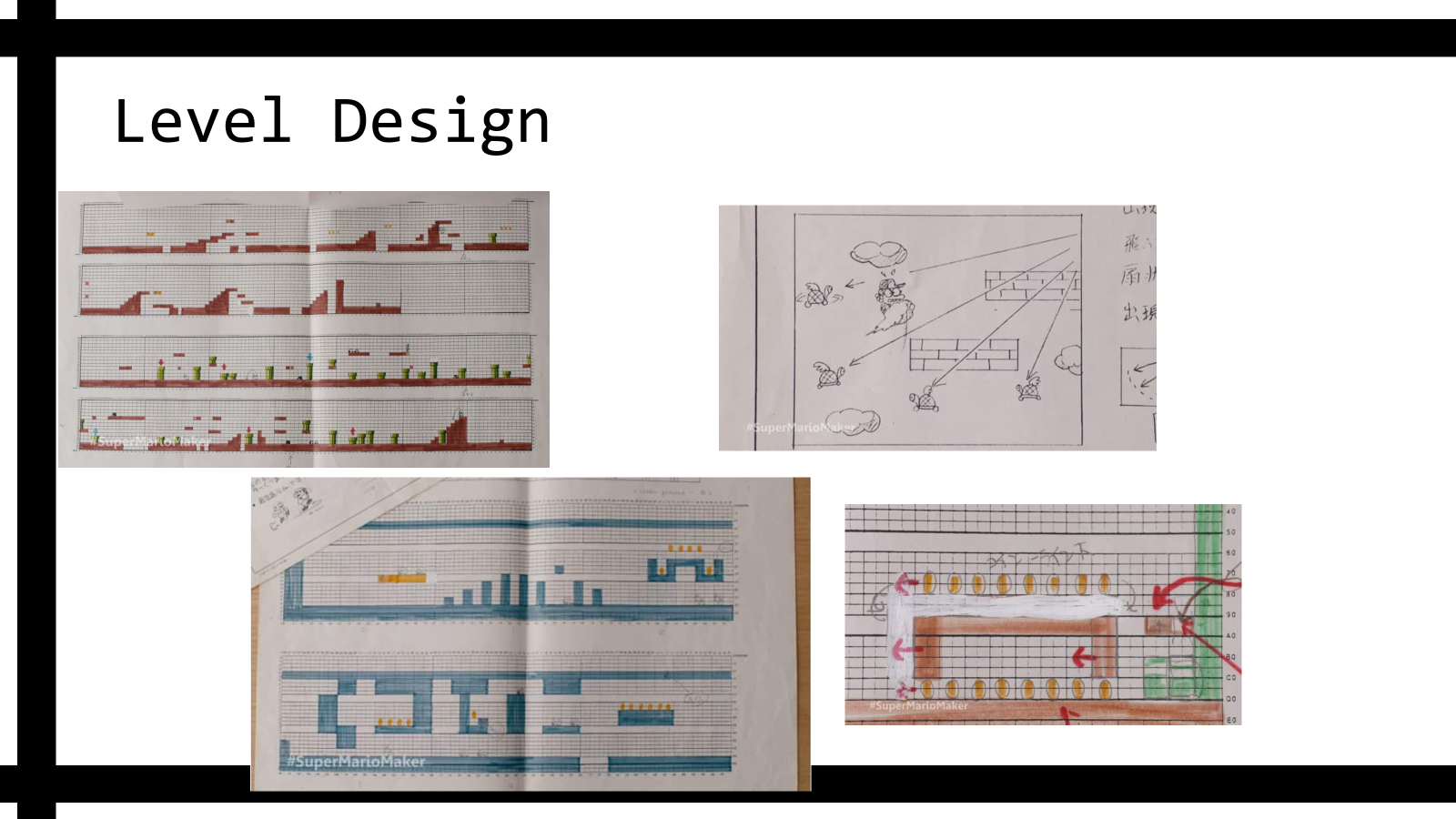
- Here's one of the most famous examples of all time
- Hand drawn levels from the original Super Mario Bros.
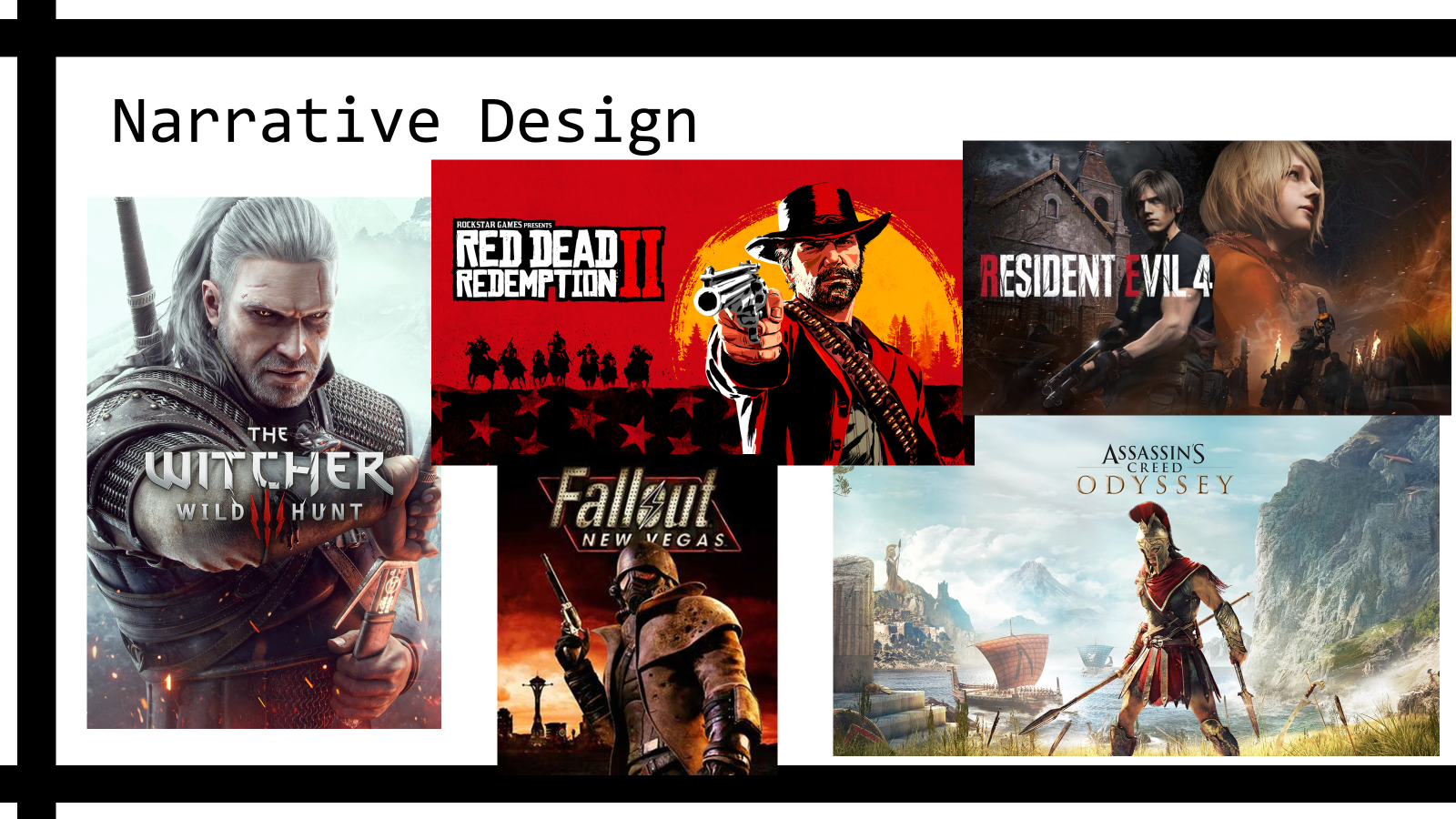
- Some games even need a story
- My favorite games don't really
- But some do!
- This is a whole art it and of itself
- Video games are starting to be adapted into movies and TV shows, which is crazy to me

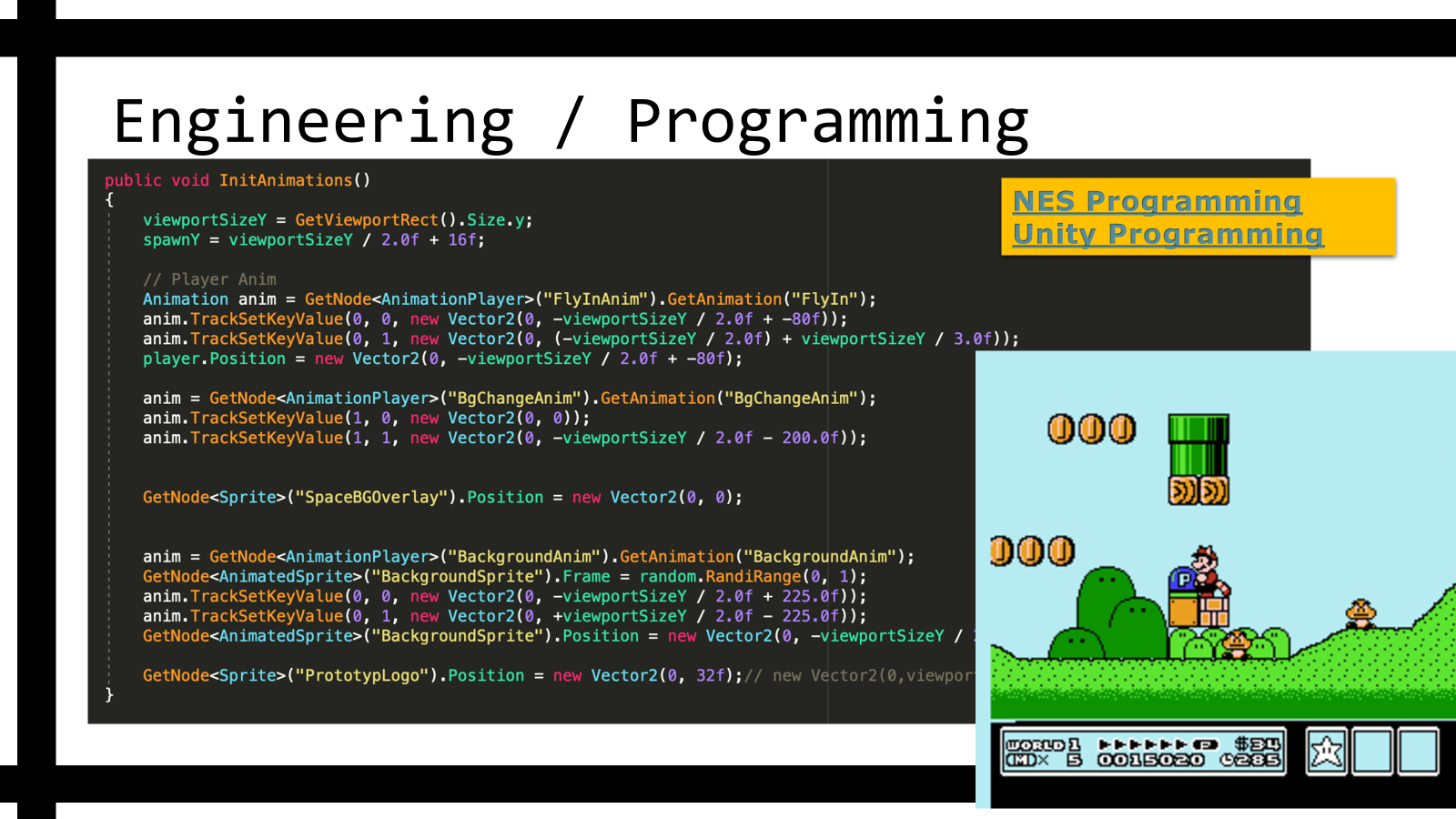
- NES Programming
- Unity Programming
- remember--everything has to by quantifiable and systematic
- a lot of programming comes down to IF-THEN rules
- who has heard of these?
- a lot of programming comes down to IF-THEN rules
- Look at the picture of Mario
- If it's just a picture, or even just an animation, you can't play it
- I can make an animation of Mario stomping on a goomba, but you can't play it
- In order to play it, you have to design a system that keeps track of what?
- Mario's position
- His motion
- His state: standing, ducking, running, jumping, underwater, big, small, racoon tail
- Now look at the goomba
- It needs AI
- not THAT kind of AI, it doesn't have to be as complex as ChatGPT
- but it needs to perform certain actions:
- walk forward
- collide--walk the other way or keep pushing?
- walk off the edge
- get stomped
- Some enemies have different abilities:
- some shoot fireballs
- some jump
- some fly
- It needs AI
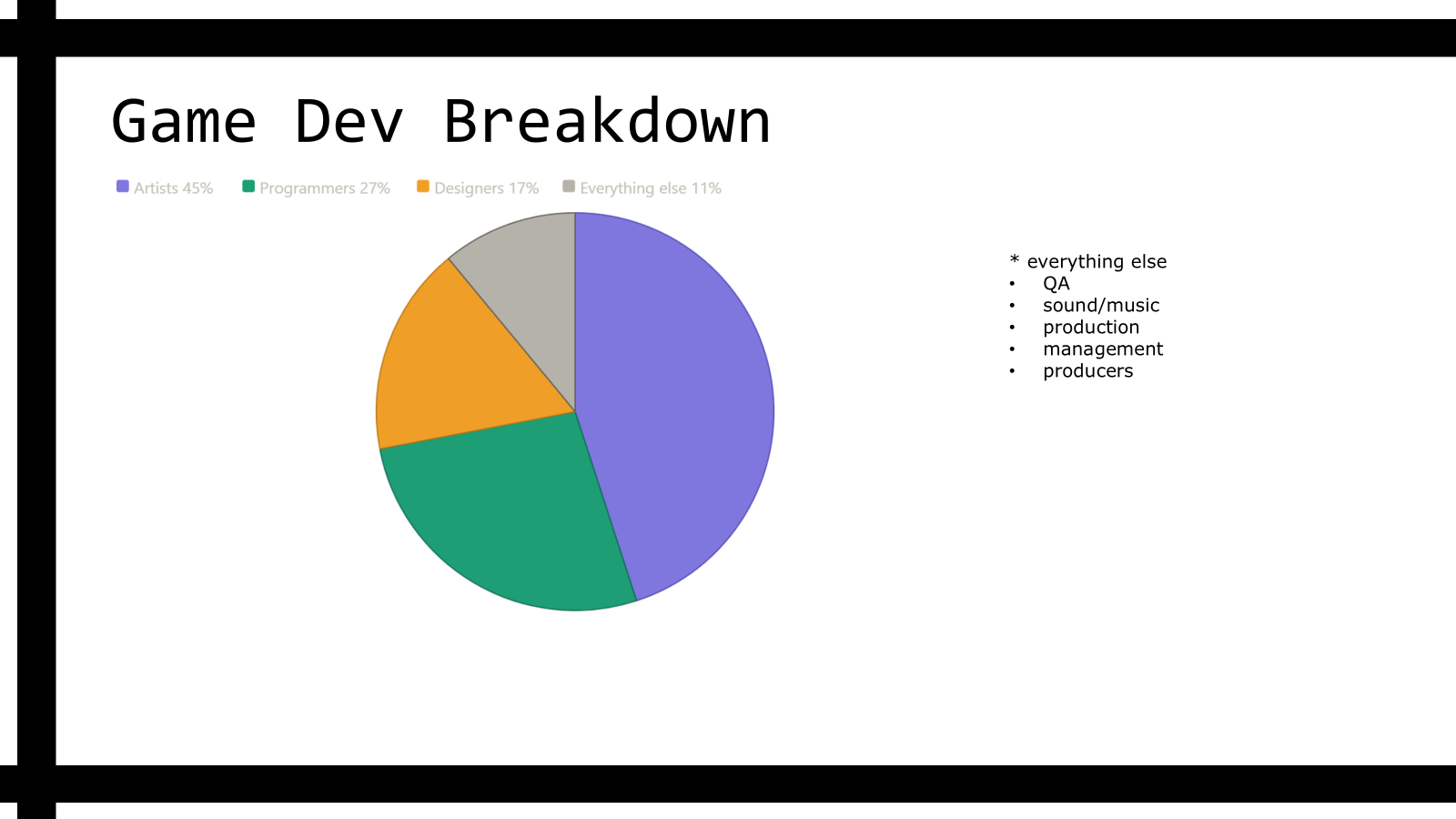
- Artists 45%
- Programmers 27%
- make more $ than artists and designers
- Designers 17%
- Other 11%
- OK its time to do game design
- Remember, we're doing an "offline" game design
- but remember--Mario started out this way!
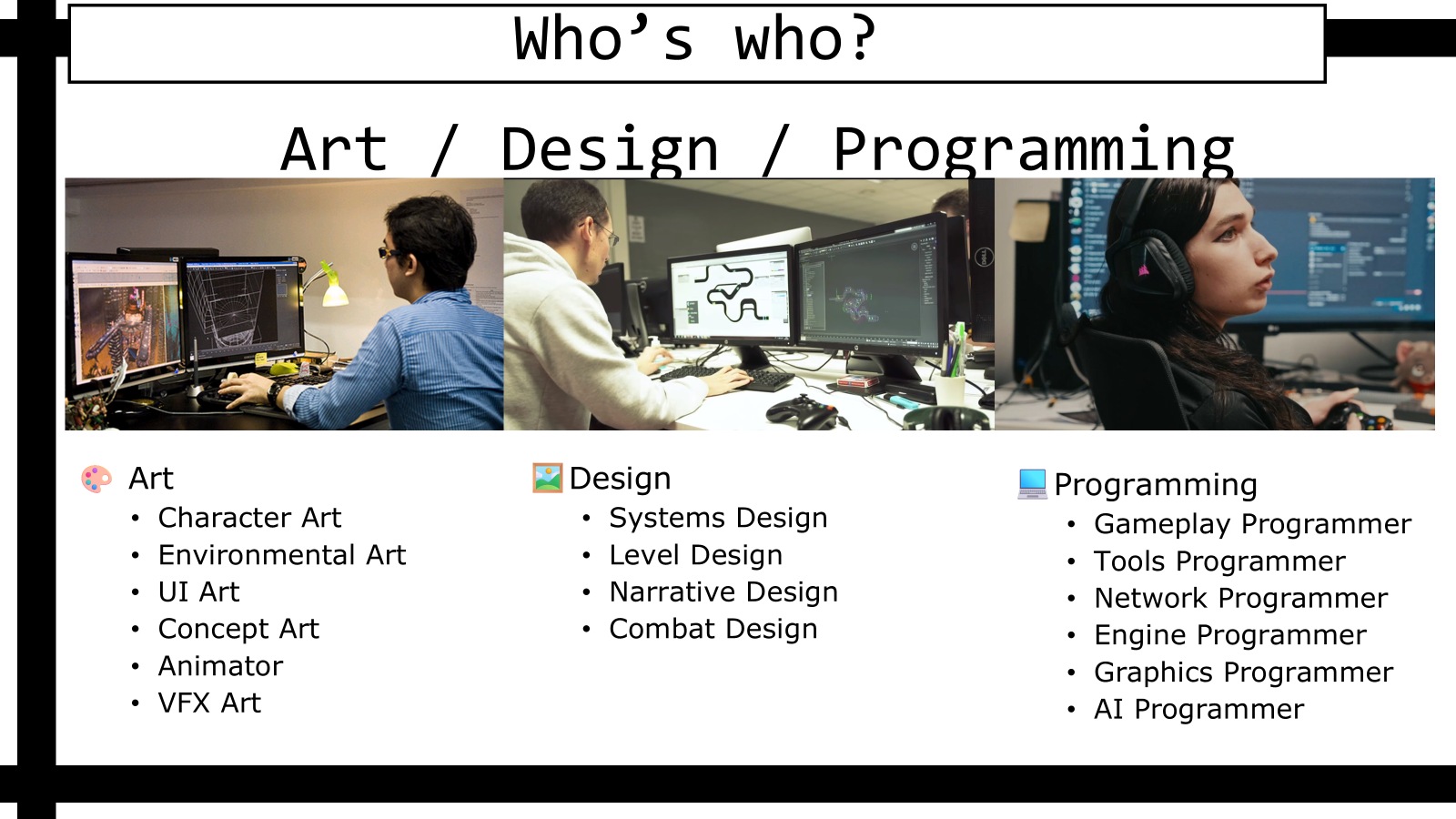
- I need you to think about which role best fits you
- Or, which role is the least bad fit!
- [Group Setup]
- Make 3 corners of the room; ask students to migrate toward that part of the room
- For 18 students:
- 5 groups of 4-5 students
- For each group of Artist, Designer, Programmer:
- Ask students to remember the number you give them
- Number them 1-5
- Have all like numbers form a group together
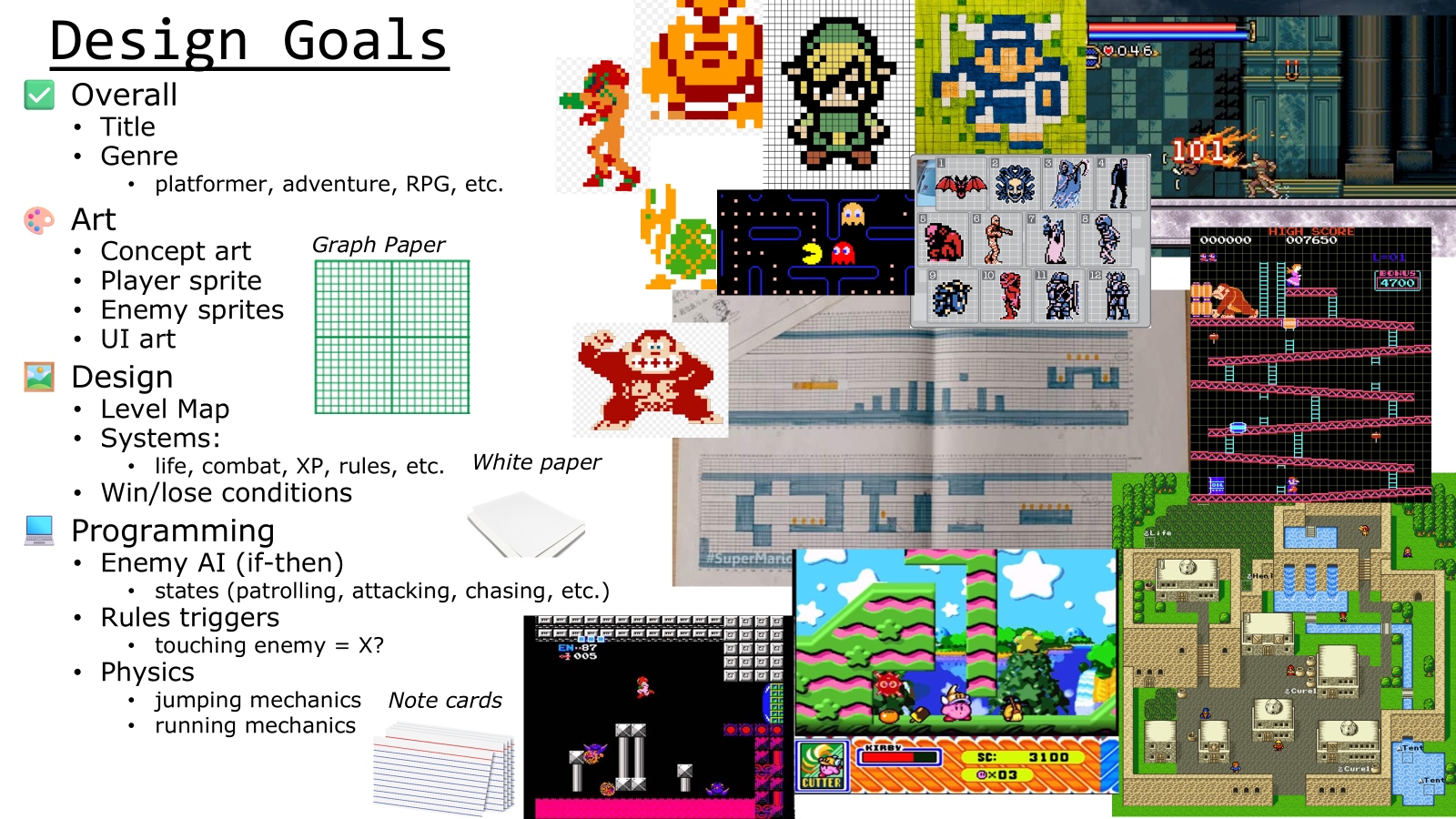
- Timing:
- use windows clock countdown
- Sprints:
- Overall - [5 mins]
- Title
- Genre
- Talk about your favorite games and what excites you, what kind of game you would like to build
- Try to find some common ground
- Remember, if you aren't thrilled with this concept, you have the rest of your life to make the one you really want to make!
- Building Phase - [20-40 mins]
- Artists
- Use either graph paper for pixel are or white paper for concept drawings
- Designer
- Use either graph paper or white paper for level designs
- Use either graph paper or white paper for system design documents
- win/lose conditions
- life, combat
- Programmers
- Use note cards for hero enemy AI
- Basically rules cards
- Use note cards for hero enemy AI
- Simple version might look like this:
- Level map (designer)
- Hero sprite (artist)
- Enemy sprites (artist)
- Rules cards (programmer)
- And if you have more time--do more!
- Remember, all the pieces work together!
- System designs have to be programmed
- Enemy sprites need AI
- Hero sprites need systems designed around them
- The level designer needs to know how high the hero can jump before he designs the level!
- Is there double jump? is there a wall jump?
- Artists
- Overall - [5 mins]
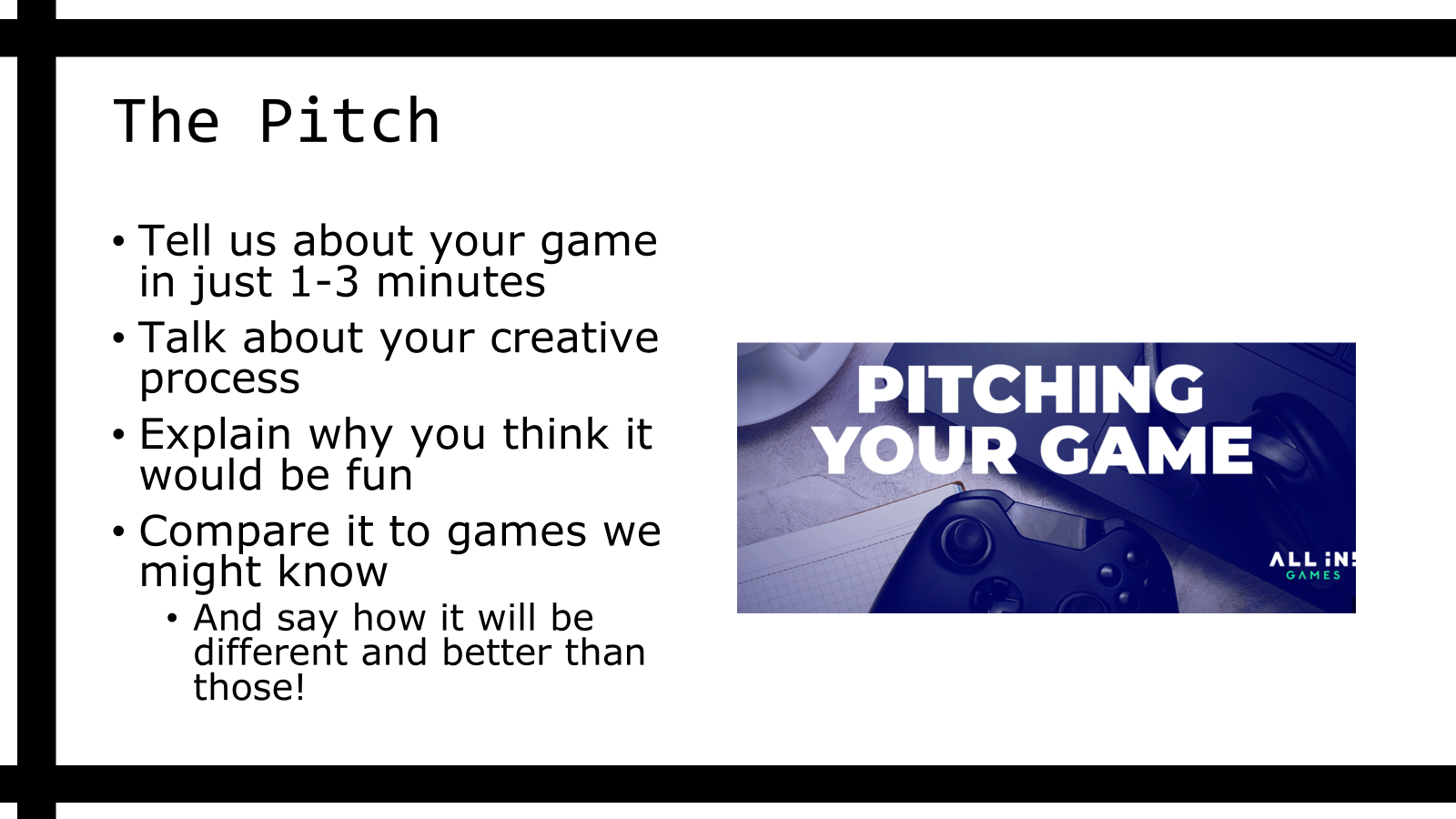
- Pitch: [20 mins]
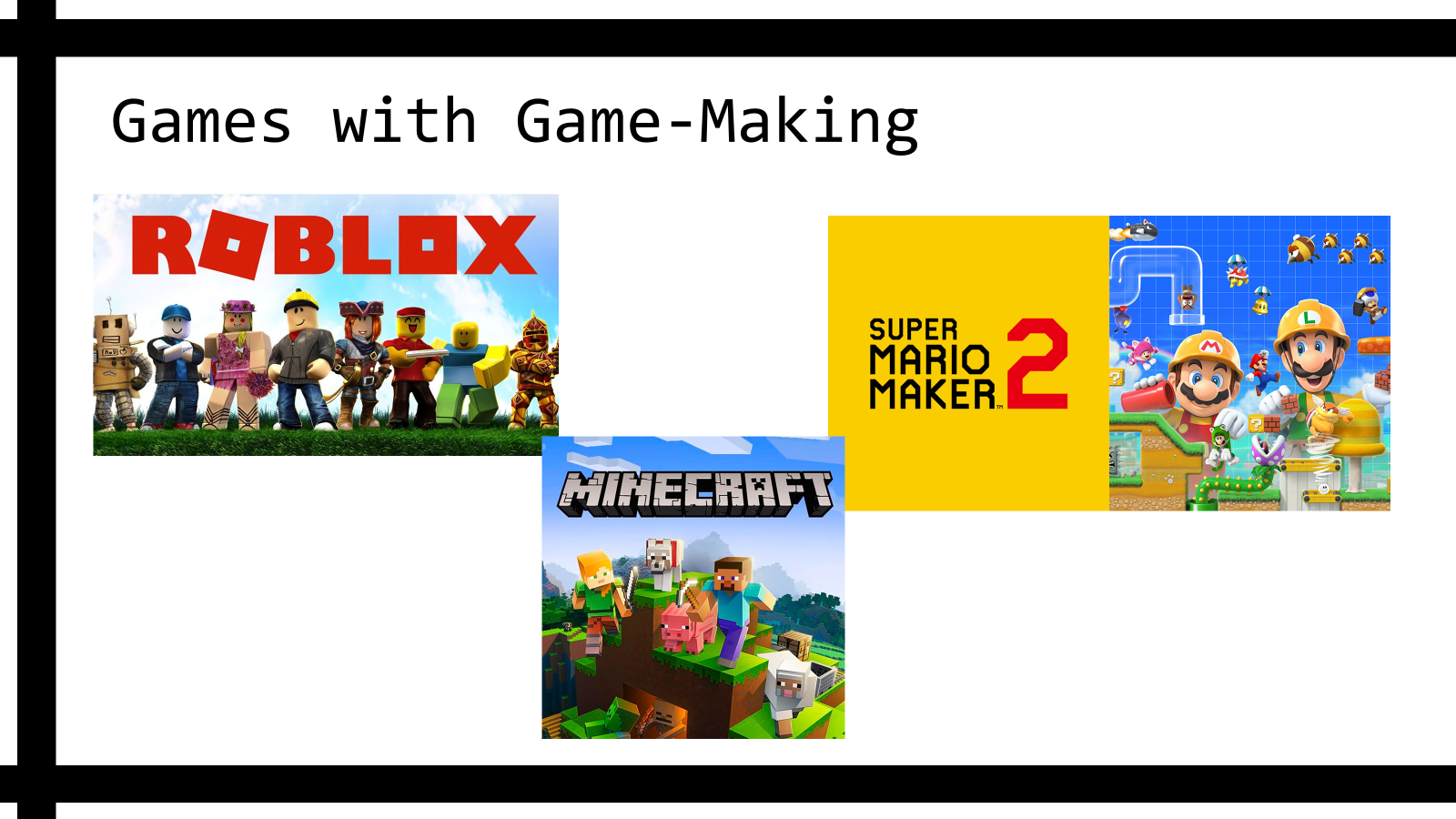
- A lot of game designers start by making levels before they ever write code. Levels are "the playground" of a game 🏟️
- Watching someone else play your level teaches you a lot. If everyone gets stuck at the same jump… that jump might be unfair 😅
- Games with creators can last forever because players keep making new content 🔥
- "Creator mode" games turn imagination into something other people can actually experience. That's powerful 🧠➡️🌍
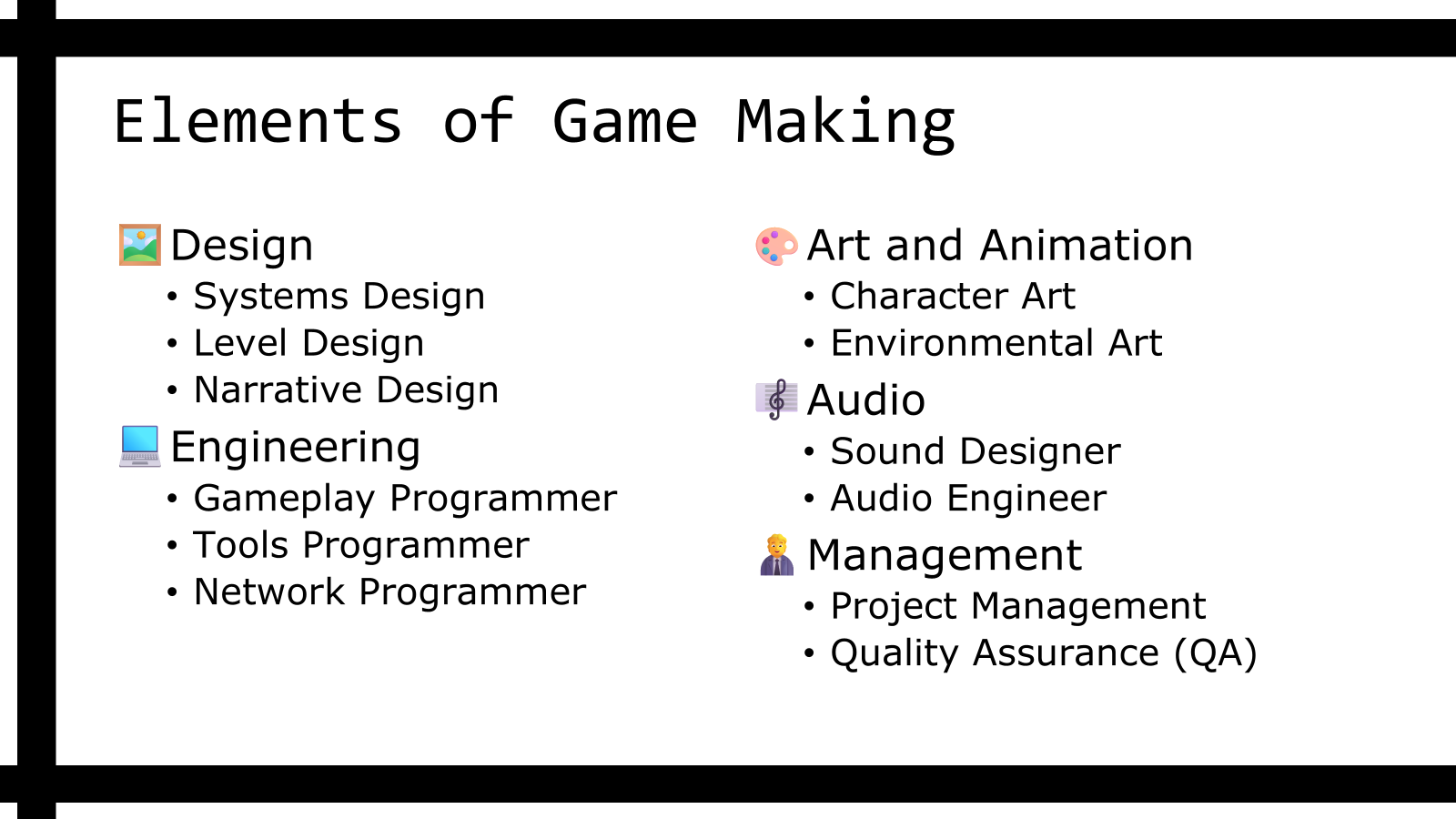
- each one of these is a job
- multiple jobs in fact! the bigger the game, the more of these jobs there are
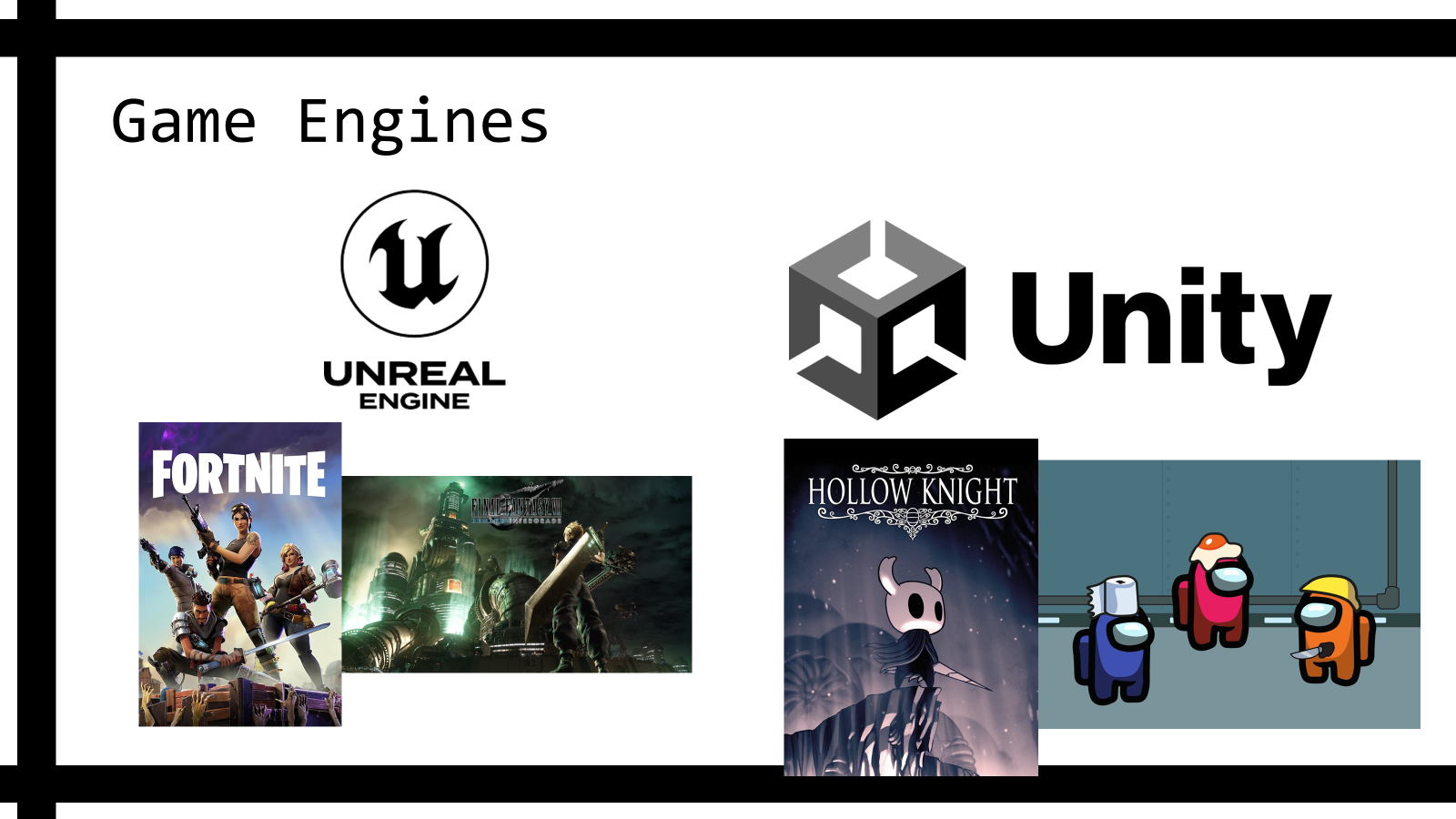
- Now the unfortunate part is that the engines it takes to make these games are only available to professional developers--that's really sad
- How many of you would actually love to use these tools if you could?
- OK good news--I lied, they're actually free and you can download them tonight and start using them.
- There's no excuse not to--in fact, do that. That's your homework.
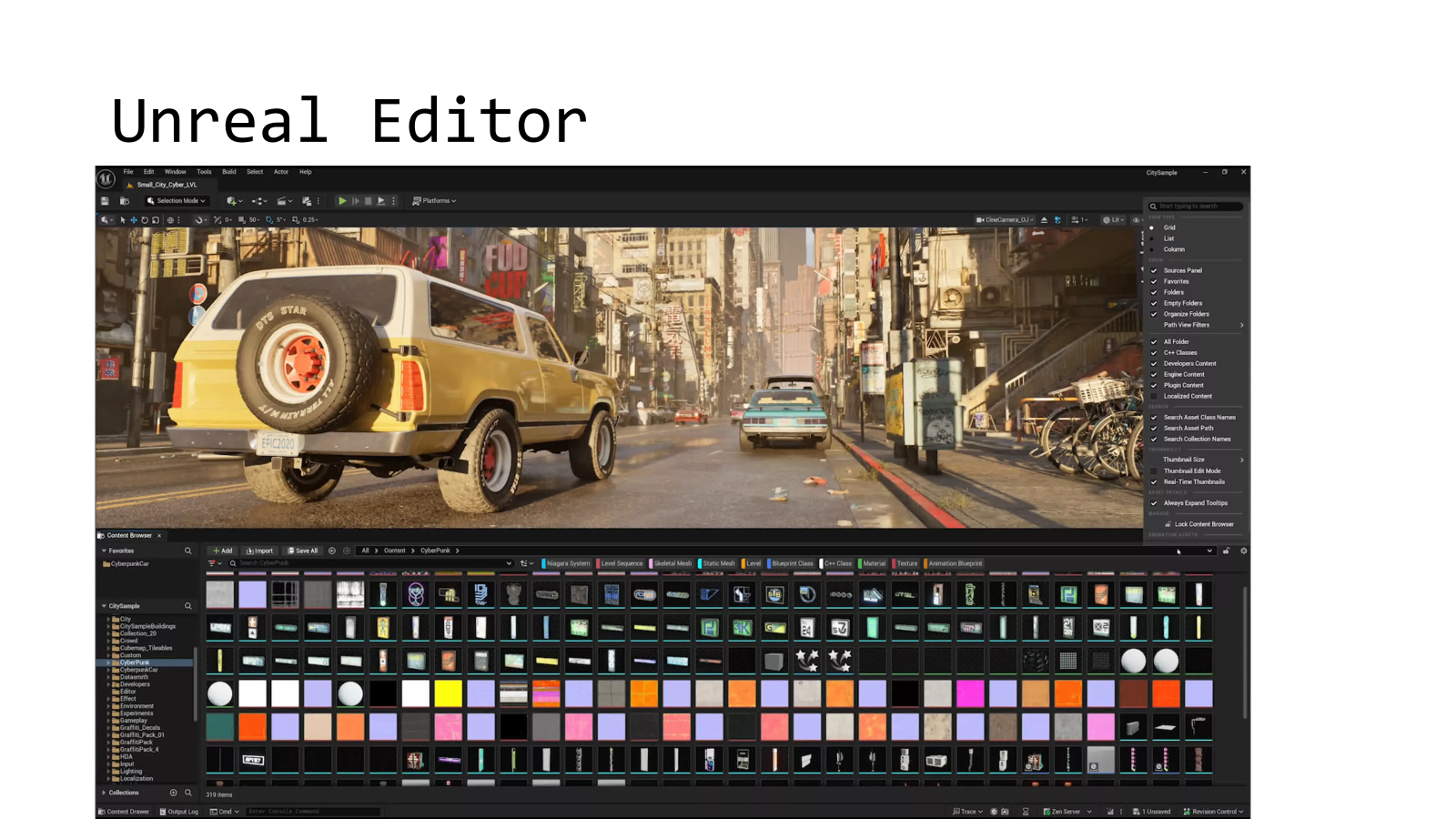
Unreal Editor
- Viewport = the big window showing the world (what you're building) 🎥
- Assets = saved stuff like models, textures, sounds (assets = "game ingredients") 🧱🎨🎵
- Super detailed scene = lots of objects + lighting + materials (materials = what surfaces look like, like metal or wood) ✨
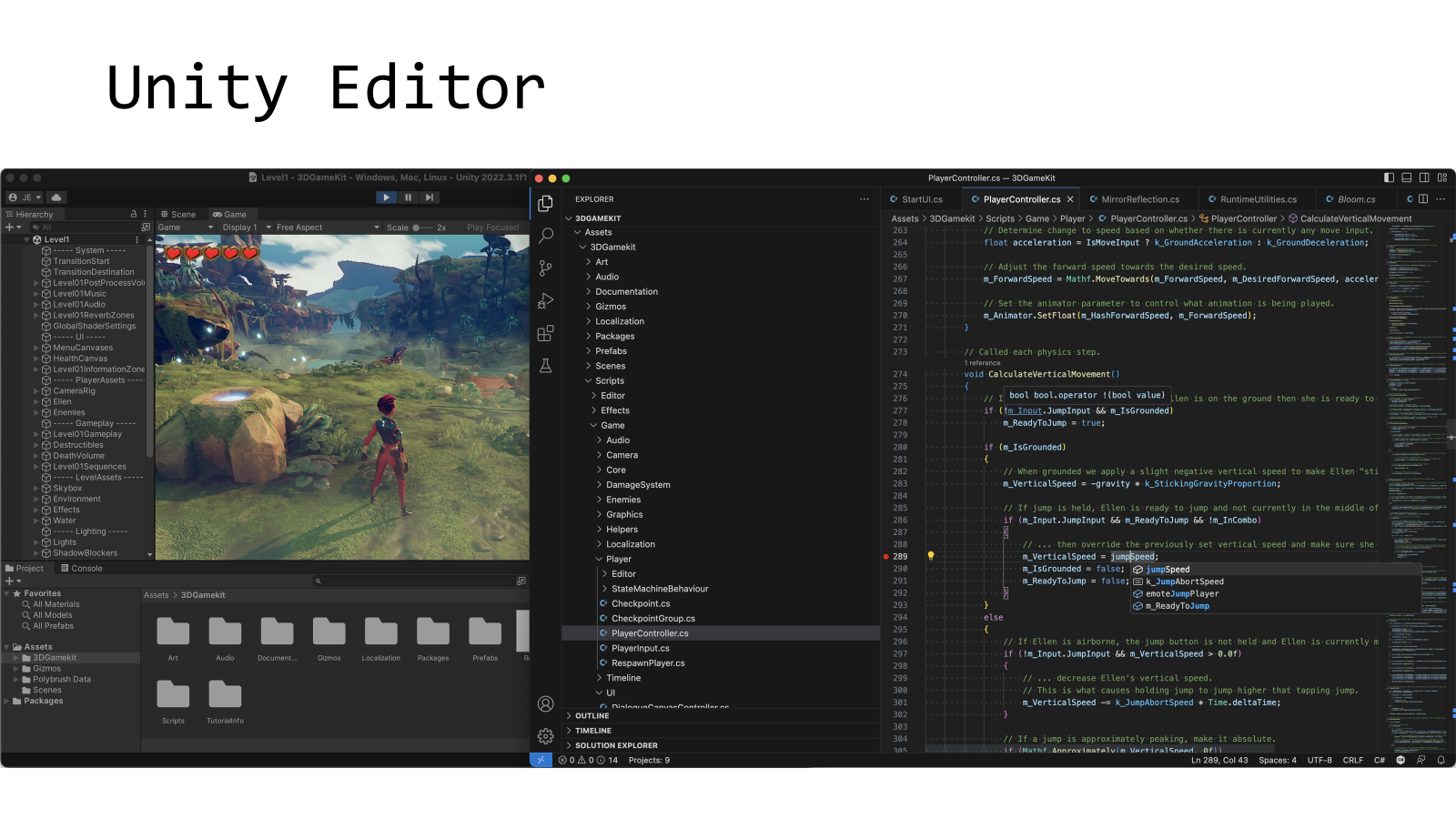
Unity Editor
- Scene/Game view = build mode vs play mode 🎥▶️
- Hierarchy = a list of everything in the level (characters, lights, trees) 📋
- Project/Assets = your files and game ingredients 🗂️
- Code window = scripts (scripts = code instructions that tell objects what to do) 💻